
JN0-281 · Question #23
Referring to the exhibit, which two statements are correct about default BGP advertisements? (Choose two.)
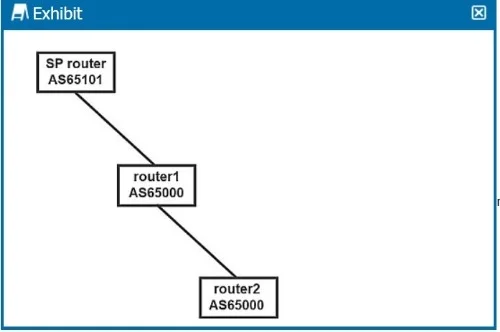
The correct answer is B. When routes advertised by router2 are received by the SP router, they will contain the next-hop D. When routes advertised by the SP router are received by router2, they will contain the next-hop. The exhibit shows a BGP peering scenario between three routers: router1 and router2 are part of the same AS (AS65000), while the SP router is in a different AS (AS65101). This indicates an EBGP (External BGP) peering between the SP router and router1, and IBGP between router1…
Question
Referring to the exhibit, which two statements are correct about default BGP advertisements? (Choose two.)
Exhibit
Options
- AWhen routes advertised by router2 are received by the SP router, they will contain the next-hop
- BWhen routes advertised by router2 are received by the SP router, they will contain the next-hop
- CWhen routes advertised by the SP router are received by router2, they will contain the next-hop
- DWhen routes advertised by the SP router are received by router2, they will contain the next-hop
How the community answered
(38 responses)- A5% (2)
- B82% (31)
- C13% (5)
Explanation
The exhibit shows a BGP peering scenario between three routers: router1 and router2 are part of the same AS (AS65000), while the SP router is in a different AS (AS65101). This indicates an EBGP (External BGP) peering between the SP router and router1, and IBGP between router1 Next-Hop Behavior in BGP: IBGP: In IBGP, the next-hop address is not modified when advertising routes within the same AS. Thus, when router1 advertises routes learned from router2 to the SP router, it will keep the next- hop address of router1, not router2. EBGP: In EBGP, the next-hop address is modified. When router1 receives routes from the SP router, it will advertise them to router2 with the next-hop address of router1. Route Propagation: Routes received by router1 from router2 will be advertised to the SP router with router1 as the Similarly, routes advertised by the SP router will be passed on to router2, with router1 remaining as the next hop.
Topics
Community Discussion
No community discussion yet for this question.