
ISO-IEC-27001-LEAD-AUDITOR · Question #71
Drag and Drop Question Match the correct responsibility with each participant of a second-party audit: Answer:
The correct answer is Audit Team Leader; Auditor in training; Auditor; Auditor; Observer; Guide. Second-Party Audit: Participant Responsibilities > Note: The question as provided is missing the 6 responsibility descriptions (the items on the left side of the drag-and-drop). The answer below is based on ISO 19011:2018 definitions, which is the standard source for this type…
Question
Drag and Drop Question Match the correct responsibility with each participant of a second-party audit:
Answer:
Exhibit
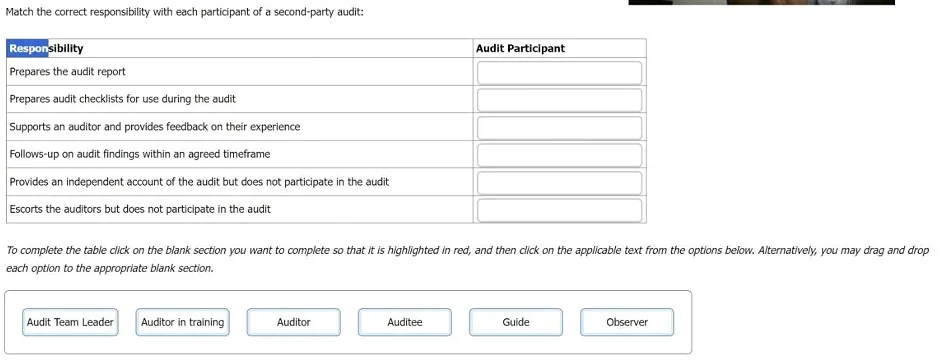
Answer Area
Drag items
Correct arrangement
- Audit Team Leader
- Auditor in training
- Auditor
- Auditor
- Observer
- Guide
Explanation
Second-Party Audit: Participant Responsibilities
Note: The question as provided is missing the 6 responsibility descriptions (the items on the left side of the drag-and-drop). The answer below is based on ISO 19011:2018 definitions, which is the standard source for this type of exam question.
The Standard Roles and Their Responsibilities
Based on ISO 19011, the 6 positions most likely map to these responsibilities:
| Position | Role | Responsibility |
|---|---|---|
| 1 | Audit Team Leader | Leads the audit team; plans, directs, and reports the audit |
| 2 | Auditor in Training | Performs audit activities under the supervision of an auditor |
| 3 | Auditor | Collects and analyzes objective evidence against audit criteria |
| 4 | Auditor | Prepares and performs assigned audit activities; documents findings |
| 5 | Observer | Accompanies the team but does NOT actively participate in auditing |
| 6 | Guide | Assigned by the auditee to facilitate access and ensure compliance with site rules |
Individual Placement Rationale
Position 1 - Audit Team Leader The ATL is the single point of accountability. Only the ATL communicates audit objectives to the auditee, submits the final audit report, and resolves disagreements between auditors and auditees. No other role can do this.
Position 2 - Auditor in Training An auditor in training is gaining competency - they perform real audit work but must be supervised. They cannot independently lead interviews or determine findings. This is distinct from a full "Auditor."
Positions 3 & 4 - Auditor (appears twice) Two separate responsibilities are assigned to auditors because auditors handle both the collection of evidence and the documentation/preparation of findings. These are often tested as distinct duties. Both belong to "Auditor" (not the team leader, who has broader strategic duties).
Position 5 - Observer Observers are present to witness the audit process (e.g., a regulator or client representative). They have no audit responsibilities - they do not ask questions, evaluate evidence, or write findings. Their role is passive.
Position 6 - Guide The guide is assigned by the auditee organization, not the audit team. Their job is logistical: escort the audit team, arrange access to personnel and areas, and ensure on-site rules are followed. They are not auditors.
Common Mistakes
- Confusing Guide with Observer: The guide is from the auditee's side; the observer is typically from the client/auditor's side. The guide facilitates access; the observer just watches.
- Assuming the ATL also audits: The ATL can audit, but their listed responsibilities in ISO 19011 are primarily leadership/coordination duties - exams test these as separate from "Auditor" duties.
- Placing "Auditor in Training" as an Observer: Trainees actively participate (under supervision); observers do not participate at all.
- Thinking "Guide" is part of the audit team: Per ISO 19011 clause 5.5.4, guides are auditee-assigned and are not audit team members.
Topics
Community Discussion
No community discussion yet for this question.