
ISO-IEC-27001-LEAD-AUDITOR · Question #101
Drag and Drop Question Auditors need to communicate effectively with auditees. Therefore, their personal behaviour is a key characteristic needed to ensure a successful audit. Below there are the…
The correct answer is Observant; Ethical; Tenacious; Open to improvement; Diplomatic; Perceptive. Auditor Personal Behaviour Characteristics - Explained This question is based on ISO 19011 (Guidelines for Auditing Management Systems), which defines specific personal behaviour characteristics for auditors. The descriptions in the exam correspond to the ISO 19011 standard…
Question
Drag and Drop Question Auditors need to communicate effectively with auditees. Therefore, their personal behaviour is a key characteristic needed to ensure a successful audit. Below there are the characteristics and a brief related description. Match the characteristics to the descriptions. Answer:
Exhibit
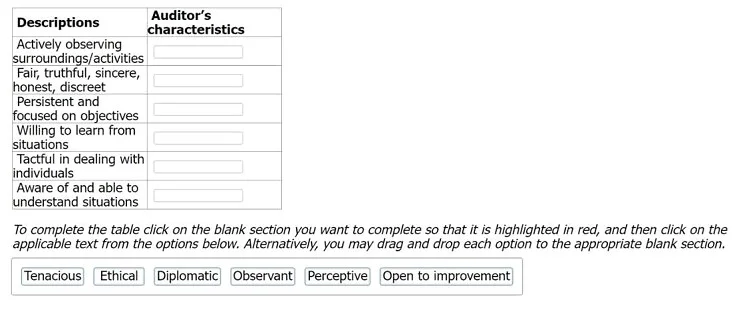
Answer Area
Drag items
Correct arrangement
- Observant
- Ethical
- Tenacious
- Open to improvement
- Diplomatic
- Perceptive
Explanation
Auditor Personal Behaviour Characteristics - Explained
This question is based on ISO 19011 (Guidelines for Auditing Management Systems), which defines specific personal behaviour characteristics for auditors. The descriptions in the exam correspond to the ISO 19011 standard definitions. Here is each placement explained:
1. Observant
ISO definition: Actively aware of physical surroundings and activities.
This is a sensory/perceptual action word - it's about what the auditor notices in real time (e.g., spotting a safety hazard on the floor, noticing a process deviation). It comes first as it's the most tangible, outward-facing trait.
Common mistake: Confusing "Observant" with "Perceptive." Observant = noticing things; Perceptive = understanding what they mean.
2. Ethical
ISO definition: Fair, truthful, sincere, honest, and discreet.
Ethics underpins the entire auditing profession. The description will reference honesty, fairness, and confidentiality. It is foundational to auditor credibility.
Common mistake: Students sometimes match "Diplomatic" here because diplomacy sounds "professional." Diplomacy is about how you communicate; ethics is about integrity.
3. Tenacious
ISO definition: Persistent and focused on achieving objectives.
The description refers to not giving up when audit evidence is hard to find, or when auditees are resistant. An auditor must follow through systematically.
Common mistake: Mixing up "Tenacious" with "Diplomatic." Tenacity is about persistence toward a goal, not about managing interpersonal tone.
4. Open to improvement
ISO definition: Willing to learn from situations and strive for better audit outcomes.
The description here will reference learning, self-reflection, and not assuming your current approach is always best. This is a self-directed trait.
Common mistake: Students sometimes place "Perceptive" here since understanding situations sounds like learning. But perceptive is about reading situations; open to improvement is about growing from them.
5. Diplomatic
ISO definition: Tactful in dealing with people.
The description refers to handling difficult conversations, delivering findings sensitively, and maintaining professional relationships with auditees - even when delivering bad news.
Common mistake: Placing "Ethical" here. Ethics governs your values; diplomacy governs your communication style.
6. Perceptive
ISO definition: Aware of and able to understand situations.
The description will reference reading context, understanding what is really happening beneath the surface, and recognizing implications. This is a cognitive interpretation skill - deeper than just observing.
Common mistake: This is the most frequently swapped item with "Observant." Remember the distinction:
- Observant = sees the thing
- Perceptive = understands what the thing means
Quick Memory Aid
| # | Characteristic | Core idea |
|---|---|---|
| 1 | Observant | See it |
| 2 | Ethical | Be honest/fair |
| 3 | Tenacious | Don't give up |
| 4 | Open to improvement | Keep learning |
| 5 | Diplomatic | Communicate tactfully |
| 6 | Perceptive | Understand what you see |
The most common exam error is swapping Observant/Perceptive and Ethical/Diplomatic - keep the see vs. understand and values vs. tone distinctions clear and you'll get it right.
Topics
Community Discussion
No community discussion yet for this question.