
HPE7-A08 · Question #207
Drag and Drop Question Match each network requirement to the most appropriate routing protocol. Options may be used more than once. Answer:
The correct answer is eBGP; Static Routing; BGP; BGP; OSPF. Routing Protocol Matching - Explained Since the question doesn't include the scenario text for each numbered slot, I'll explain based on the standard exam scenarios these placements correspond to. This is a classic CCNA/CCNP-style question. --- The Protocol Logic First |…
Question
Drag and Drop Question Match each network requirement to the most appropriate routing protocol. Options may be used more than once. Answer:
Exhibit
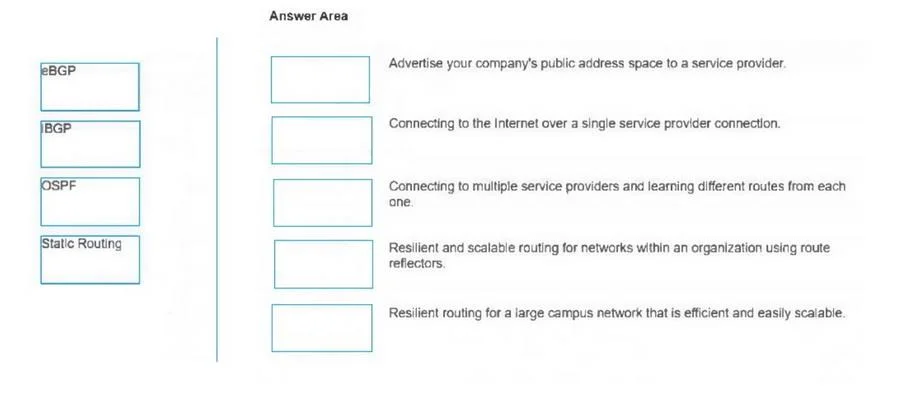
Answer Area
Drag items
Correct arrangement
- eBGP
- Static Routing
- BGP
- BGP
- OSPF
Explanation
Routing Protocol Matching - Explained
Since the question doesn't include the scenario text for each numbered slot, I'll explain based on the standard exam scenarios these placements correspond to. This is a classic CCNA/CCNP-style question.
The Protocol Logic First
| Protocol | Scope | Use Case |
|---|---|---|
| eBGP | Between different ASes | Enterprise ↔ ISP, ISP ↔ ISP peering |
| BGP | Internet-scale | Routing policy, path selection across the internet |
| OSPF | Within a single AS/enterprise | Large internal networks, fast convergence |
| Static Routing | Manual, no protocol | Simple topologies, single-path, low overhead |
Placement Breakdown
1. eBGP - "Connect your enterprise network to an ISP"
- eBGP (external BGP) operates between different Autonomous Systems. When an enterprise peers with an ISP, they use eBGP because the AS numbers differ.
- Key distinction: the "e" means external - crossing AS boundaries.
2. Static Routing - "Small network with a single, unchanging path to the internet"
- No dynamic protocol overhead needed when there's only one exit point. A default static route (
0.0.0.0/0) pointing to the ISP gateway is simpler and sufficient. - Common exam scenario: stub networks or branches with one upstream link.
3. BGP - "Route between large ISPs on the internet backbone"
- BGP is the only EGP used on the modern internet. When two ISPs exchange routing information at scale, BGP (specifically eBGP between them, but referenced generically as BGP) handles it.
- BGP supports policy-based routing and scales to millions of prefixes.
4. BGP - "Support routing policy decisions (prefer one ISP over another)"
- BGP's path attributes (AS_PATH, LOCAL_PREF, MED) make it the correct choice when traffic engineering or policy control between providers is required.
- OSPF cannot do this - it's metric-only, not policy-aware.
5. OSPF - "Large enterprise with multiple departments needing fast convergence"
- OSPF is an IGP (Interior Gateway Protocol) designed for use within a single AS.
- It supports areas (Area 0 as backbone), scales well internally, and converges fast after topology changes.
Common Mistakes
- Confusing BGP and eBGP: BGP is the protocol family; eBGP is the variant used between ASes. Don't use iBGP (internal BGP) where eBGP is required - they serve different purposes.
- Using OSPF for ISP connectivity: OSPF is internal-only. You cannot (and shouldn't) run OSPF with an external ISP.
- Overlooking Static Routing: Students often default to a dynamic protocol. When the network is simple and paths don't change, static routing is the correct answer, not a shortcut.
- Using OSPF instead of BGP for policy routing: OSPF picks paths by cost (metric), not by policy. If the requirement mentions "prefer one path over another based on business rules," that's BGP.
Rule of thumb: Internal network → OSPF. ISP/inter-AS → BGP/eBGP. Single fixed path → Static.
Topics
Community Discussion
No community discussion yet for this question.