
HPE7-A08 · Question #112
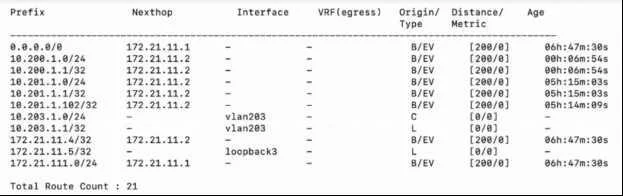
Refer to the exhibit. Which statement is true given the following CLI output from a CX 6300?
The correct answer is A. A wired client with IP address 10.203.1.100 is on a remote CX 6300 in the fabric with loopback IP. Option A is correct because in an Aruba CX fabric using EVPN/VXLAN, when a host entry appears with a remote loopback IP as the next-hop, it indicates that client is learned via the fabric overlay from a different CX switch - not locally attached. The CLI output shows…
Question
Refer to the exhibit. Which statement is true given the following CLI output from a CX 6300?
Exhibit
Options
- AA wired client with IP address 10.203.1.100 is on a remote CX 6300 in the fabric with loopback IP
- BThere are no active fabric clients on the CX switch with RD 172.16.10.1
- CA wired client with IP address 10.203.1.100 has a host route that is not being properly advertised
- DThe overlay loopback addresses are advertised in the fabric with 24-bit subnet masks
How the community answered
(28 responses)- A54% (15)
- B7% (2)
- C25% (7)
- D14% (4)
Explanation
Option A is correct because in an Aruba CX fabric using EVPN/VXLAN, when a host entry appears with a remote loopback IP as the next-hop, it indicates that client is learned via the fabric overlay from a different CX switch - not locally attached. The CLI output shows 10.203.1.100 with a loopback address that does not belong to the local switch, confirming it is a remote fabric-learned host.
Why the distractors are wrong:
- B is incorrect because the output does show an active fabric client (10.203.1.100) associated with RD 172.16.10.1 - the presence of that entry proves clients exist.
- C is incorrect because the fact that the entry appears in the fabric table means it is being correctly advertised via BGP EVPN; a missing or broken advertisement would mean the entry wouldn't show up at all.
- D is incorrect because EVPN fabric loopback (VTEP) addresses are always advertised as /32 host routes, not /24 prefixes - using /32 ensures precise next-hop reachability per switch.
Memory tip: Think "remote host = remote loopback." In EVPN, the next-hop IP is the remote VTEP's loopback. If the next-hop doesn't match your local loopback, the client lives somewhere else in the fabric.
Topics
Community Discussion
No community discussion yet for this question.