
HPE7-A07 · Question #15
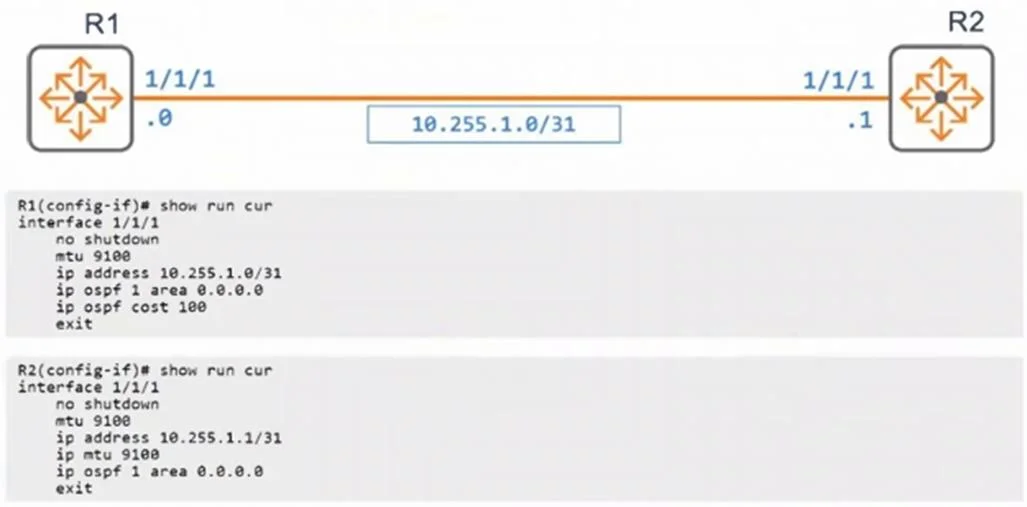
Refer to the exhibits. An engineer has applied the above configuration to R1 and R2. However, the router's OSPF adjacency never progresses past the "EXSTART/DR" state as shown below. Which…
The correct answer is A. Change R1 and R2 to a network type of point-to-point. In OSPF, the "EXSTART/DR" state indicates that the routers are trying to establish an adjacency but are unable to progress. This can happen if the OSPF network type is incorrectly configured for the type of connection between the routers. Given that R1 and R2 are connected via…
Question
Refer to the exhibits. An engineer has applied the above configuration to R1 and R2. However, the router's OSPF adjacency never progresses past the "EXSTART/DR" state as shown below. Which configuration action on either router will allow R1 and R2 to progress past the "EXSTART/DR" state?
Exhibits

Options
- AChange R1 and R2 to a network type of point-to-point.
- BRemove the layer 3 MTU configuration.
- CEnsure the OSPF process is not configured with passive-interface default.
- DChange the IP address and mask applied to interface 1/1/1.
How the community answered
(50 responses)- A80% (40)
- B2% (1)
- C6% (3)
- D12% (6)
Explanation
In OSPF, the "EXSTART/DR" state indicates that the routers are trying to establish an adjacency but are unable to progress. This can happen if the OSPF network type is incorrectly configured for the type of connection between the routers. Given that R1 and R2 are connected via a point- to-point link (as suggested by the /31 subnet), setting the network type to point-to-point on both routers will remove the need for DR/BDR election, which is unnecessary on a point-to-point link, and allow OSPF to progress past the "EXSTART" state and form a full adjacency.
Topics
Community Discussion
No community discussion yet for this question.