
HPE7-A01 · Question #121
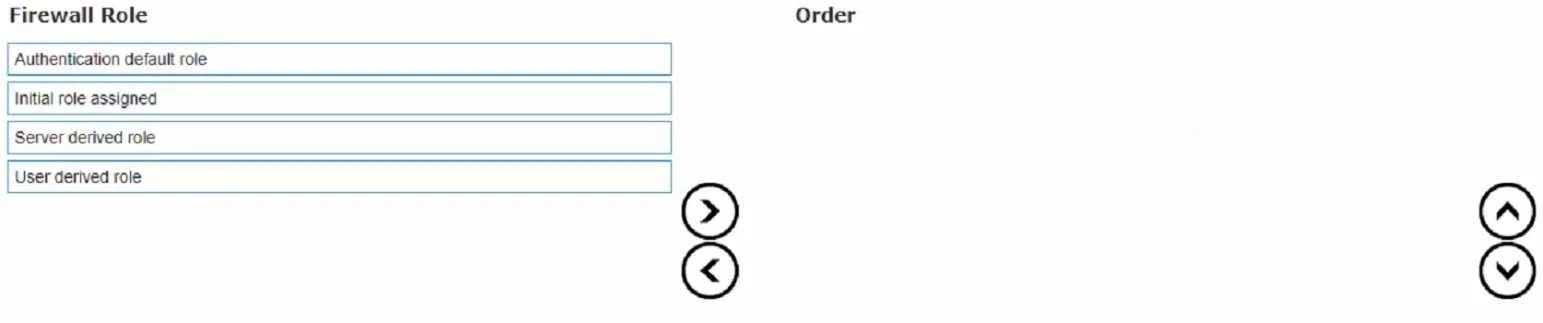
Drag and Drop Question List the firewall role derivation flow in the correct order. Answer:
The correct answer is Server derived role; User derived role; Authentication default role; Initial role assigned. Firewall Role Derivation Flow - Explained This question tests your understanding of how a firewall determines which administrative role to assign to a user during authentication. The flow represents a priority hierarchy - the system evaluates each source in order, and the first…
Question
Drag and Drop Question List the firewall role derivation flow in the correct order. Answer:
Exhibit
Answer Area
Drag items
Correct arrangement
- Server derived role
- User derived role
- Authentication default role
- Initial role assigned
Explanation
Firewall Role Derivation Flow - Explained
This question tests your understanding of how a firewall determines which administrative role to assign to a user during authentication. The flow represents a priority hierarchy - the system evaluates each source in order, and the first successful match wins. More specific/authoritative sources take precedence over generic defaults.
The Correct Order (Highest to Lowest Priority)
1. Server Derived Role (Highest Priority)
The firewall first checks whether the authentication server (RADIUS, LDAP, SAML IdP, etc.) explicitly returns a role attribute for the user (e.g., a RADIUS Vendor-Specific Attribute or LDAP group mapping).
- Why first? The external identity provider is the most authoritative and most specific source. If the server says "this user is an admin," that should override everything else.
- Common mistake: Assuming local configuration always overrides the server. It doesn't - server-sent attributes have the highest precedence.
2. User Derived Role (Second Priority)
If no server-provided role exists, the firewall checks for a locally configured user-to-role mapping - a specific role explicitly assigned to that individual user account on the device.
- Why second? User-specific local configuration is more precise than a profile-wide default, but less authoritative than what the identity server directly asserts.
- Common mistake: Confusing this with the authentication profile default. This is per-user, not per-profile.
3. Authentication Default Role (Third Priority)
If no user-specific role is found, the firewall falls back to the default role configured within the authentication profile itself - a role that applies to any user who successfully authenticates through that profile.
- Why third? It's a broad catch-all for all users of a given auth profile, so it's less specific than a per-user assignment.
- Common mistake: Thinking this is the ultimate fallback. There is still one more layer below it.
4. Initial Role Assigned (Lowest Priority / Ultimate Fallback)
The last resort - the baseline role the system assigns before any authentication-based derivation takes place. If no role can be derived from any of the above methods, this is what the user gets.
- Why last? It is the least specific assignment - a system-level default with no authentication context factored in.
- Common mistake: Treating this as the "starting point that gets upgraded." The flow is top-down priority selection, not an additive build-up.
Key Takeaway
Think of it as specificity decreasing at each step:
Server (most specific, external authority)
  → User (specific, local config)
    → Auth Profile Default (broad, profile-wide)
      → Initial Role (generic system fallback)
The first level that successfully produces a role stops the evaluation. Knowing this prevents misconfiguring auth profiles and accidentally granting or denying access due to unexpected role resolution.
Topics
Community Discussion
No community discussion yet for this question.