
HPE2-W09 · Question #64
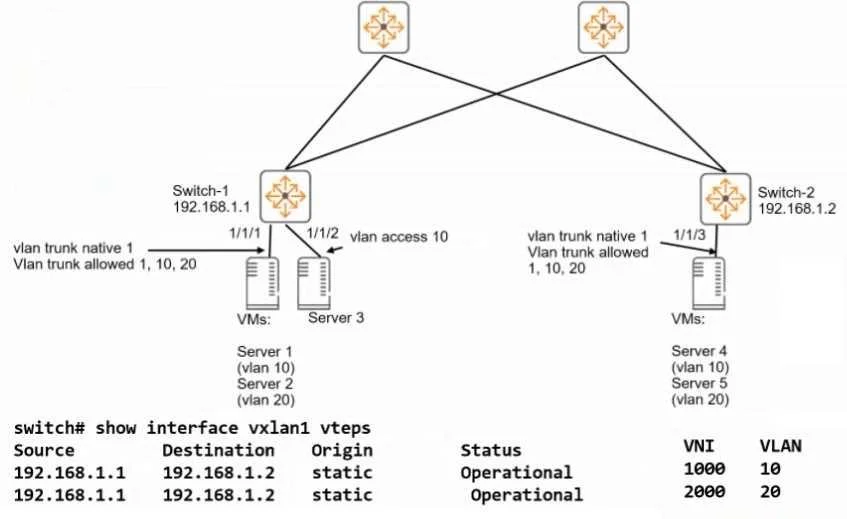
Refer to the exhibit. Switch-1 and Switch-2 ate ArubaOS-CX switches that implement VXLAN WITHOUT Ethernet VPN (EVPN). Switch-2 uses the same VNI-to-VLAN mappings as Switch-1. Is this how the…
The correct answer is B. No. The solution is incorrect because Switch-1 and Switch-2 implement VXLAN without EVPN, which means they do not have a control plane to exchange MAC addresses. Therefore, the first time that Server 1 communicates with Server 3, it sends an ARP request to resolve Server 3's IP…
Question
Refer to the exhibit. Switch-1 and Switch-2 ate ArubaOS-CX switches that implement VXLAN WITHOUT Ethernet VPN (EVPN). Switch-2 uses the same VNI-to-VLAN mappings as Switch-1. Is this how the specified servers communicate? Solution: The first time that Server I communicates with Server 3, It sends an ARP request to resolve Server 3's MAC address.
Exhibit
Options
- AYes
- BNo
How the community answered
(45 responses)- A16% (7)
- B84% (38)
Explanation
The solution is incorrect because Switch-1 and Switch-2 implement VXLAN without EVPN, which means they do not have a control plane to exchange MAC addresses. Therefore, the first time that Server 1 communicates with Server 3, it sends an ARP request to resolve Server 3's IP address, not MAC address. The ARP request is encapsulated in a VXLAN header and sent to the VTEP of Switch-2, which decapsulates it and forwards it to Server 3.
Topics
Community Discussion
No community discussion yet for this question.