
HPE2-W09 · Question #45
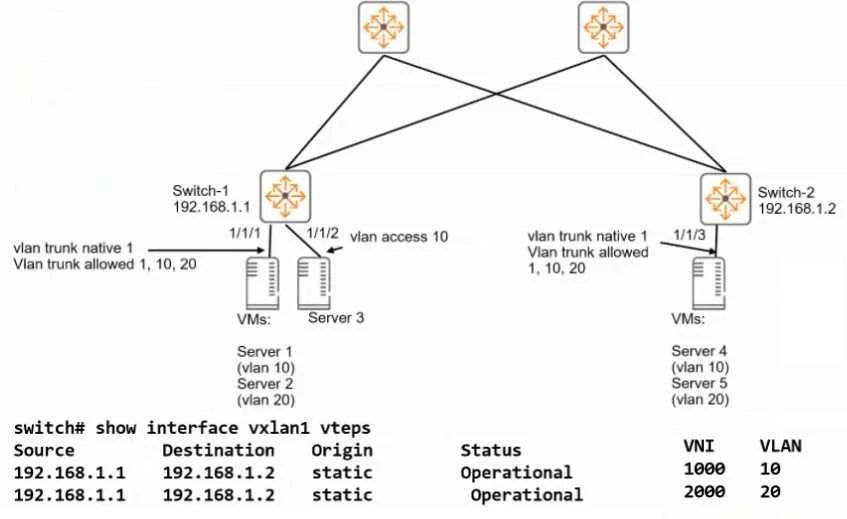
Refer to the exhibit. Switch-1 and Switch-2 ate ArubaOS-CX switches that implement VXLAN WITHOUT Ethernet VPN (EVPN). Switch-2 uses the same VNI-to-VLAN mappings as Switch-1. Is this how the…
The correct answer is B. No. The exhibit shows a network topology where Switch-1 and Switch-2 are ArubaOS-CX switches that implement VXLAN without Ethernet VPN (EVPN). Switch-2 uses the same VNI-to-VLAN mappings as Switch-1. The question asks how the specified servers communicate, which means Server 1 and…
Question
Refer to the exhibit. Switch-1 and Switch-2 ate ArubaOS-CX switches that implement VXLAN WITHOUT Ethernet VPN (EVPN). Switch-2 uses the same VNI-to-VLAN mappings as Switch-1. Is this how the specified servers communicate? Solution: Server 1 and Server 4 require routing services within the VXLANs to communicate with each other.
Exhibit
Options
- AYes
- BNo
How the community answered
(27 responses)- A19% (5)
- B81% (22)
Explanation
The exhibit shows a network topology where Switch-1 and Switch-2 are ArubaOS-CX switches that implement VXLAN without Ethernet VPN (EVPN). Switch-2 uses the same VNI-to-VLAN mappings as Switch-1. The question asks how the specified servers communicate, which means Server 1 and Server 4. Server 1 and Server 4 are in different VLANs and different VNIs, which means they are in different layer 2 segments. To communicate with each other, they require routing services between the VXLANs. However, using Virtual Routing and Forwarding (VRF) to tunnel iSCSI traffic through the network spine on the same links that data traffic uses is not the correct way to provide routing services. VRF is a technology that creates multiple isolated Layer 3 domains on a physical network, each with its own routing table. VRF does not provide any benefits for iSCSI traffic, as it does not guarantee bandwidth, priority, or quality of service. VRF also adds overhead and complexity to the network configuration. To provide routing services between the VXLANs, the correct way is to use VXLAN routing with EVPN or distributed anycast gateway (DAG). VXLAN routing with EVPN allows the switches to exchange MAC and IP information using BGP EVPN control plane, and to perform routing between different VNIs using a centralized or distributed model. DAG allows the switches to act as anycast gateways for their local hosts, and to route traffic between different VNIs using a symmetric or asymmetric model3. Therefore, this does not correctly describe how the specified servers communicate.
Topics
Community Discussion
No community discussion yet for this question.