
HPE2-W09 · Question #116
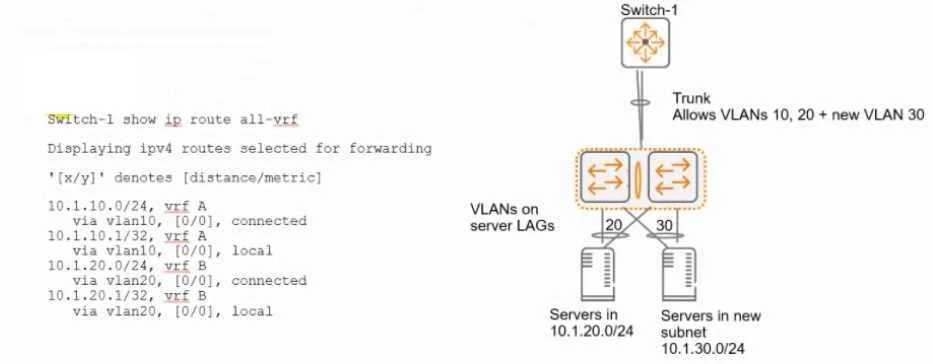
Refer to the exhibit. You are adding a VLAN 30, subnet 10.0.30.0/24 to the network shown in the exhibit. (This network is simplified to just the relevant switches for this item.) This subnet belongs…
The correct answer is B. No. The solution is incorrect because adding VRF B as the secondary VRF on VLAN interface 30 is not part of a valid setup for meeting these requirements. Adding VRF B as the secondary VRF on VLAN interface 30 would allow devices in VLAN 30 to communicate with devices in VRF B, but…
Question
Refer to the exhibit. You are adding a VLAN 30, subnet 10.0.30.0/24 to the network shown in the exhibit. (This network is simplified to just the relevant switches for this item.) This subnet belongs in VRF A, and you have added a Layer 3 VLAN 30 interface attached to this VRF on Switch-1. You want to make the services in this VLAN available to devices in 10.1.20.0/24 in VRF B. Is this part of a valid setup for meeting these requirements? Solution: Add VRF B as the secondary VRF on VLAN interface 30.
Exhibit
Options
- AYes
- BNo
How the community answered
(51 responses)- A22% (11)
- B78% (40)
Explanation
The solution is incorrect because adding VRF B as the secondary VRF on VLAN interface 30 is not part of a valid setup for meeting these requirements. Adding VRF B as the secondary VRF on VLAN interface 30 would allow devices in VLAN 30 to communicate with devices in VRF B, but not vice versa. Therefore, adding VRF B as the secondary VRF on VLAN interface 30 is not sufficient for meeting these requirements.
Topics
Community Discussion
No community discussion yet for this question.