
HP0-J67 · Question #123
You need to ensure data integrity on physical disks within the proposed HP 3PAR StoreServ Storage array. Which HP 3PAR StoreServ Storage component calculates the value of the disk T10 Data Integrity…
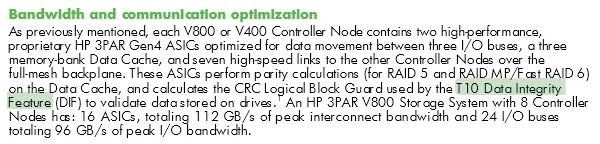
The correct answer is D. HP 3PAR Gen4 ASlC. This question asks which specific HP 3PAR StoreServ Storage component is responsible for calculating the T10 Data Integrity Feature (DIF) value to ensure data integrity on physical disks.
Question
You need to ensure data integrity on physical disks within the proposed HP 3PAR StoreServ Storage array. Which HP 3PAR StoreServ Storage component calculates the value of the disk T10 Data Integrity Feature (DIF)?
Exhibit
Options
- AHP Service Processor
- BHP InServ Controllers CPUs
- CController Cache Algorithm
- DHP 3PAR Gen4 ASlC
How the community answered
(42 responses)- A5% (2)
- B2% (1)
- D93% (39)
Why each option
This question asks which specific HP 3PAR StoreServ Storage component is responsible for calculating the T10 Data Integrity Feature (DIF) value to ensure data integrity on physical disks.
The HP Service Processor is responsible for array management, monitoring, and remote support, not for real-time data integrity calculations during I/O operations.
While controller CPUs execute overall array software, specialized tasks like T10 DIF calculations are typically offloaded to ASICs for efficiency and performance.
The Controller Cache Algorithm manages how data is stored and retrieved from cache, but it does not perform the actual mathematical calculation of DIF values.
The HP 3PAR Gen4 ASIC (Application-Specific Integrated Circuit) is a purpose-built hardware component within the 3PAR array architecture. These ASICs are specifically designed to offload computationally intensive tasks, such as real-time T10 Data Integrity Feature (DIF) calculations, from the general-purpose CPUs, ensuring high-performance, end-to-end data integrity verification at the hardware level.
Concept tested: HP 3PAR StoreServ architecture, T10 DIF, ASIC
Source: https://www.t10.org/t10dif.htm
Topics
Community Discussion
No community discussion yet for this question.