
H12-891_V1.0 · Question #179
As shown in the figure, in the scenario of dynamically establishing a VXLAN tunnel through BGP EVPN, which of the following RT values is carried by the BGP EVPN Type2 route sent by VTEP1 to VTEP2?
The correct answer is A. 10:1. Option A (10:1) is correct because BGP EVPN Type 2 routes carry the Export RT of the originating VTEP - when VTEP1 advertises a MAC/IP route, it stamps it with its own configured Export RT value, which in this topology is 10:1. Option C (20:1) is wrong because 20:1 is typically…
Question
As shown in the figure, in the scenario of dynamically establishing a VXLAN tunnel through BGP EVPN, which of the following RT values is carried by the BGP EVPN Type2 route sent by VTEP1 to VTEP2?
Exhibit
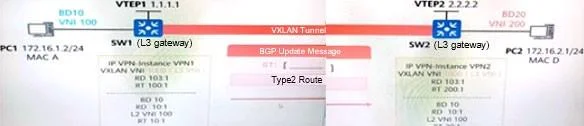
Options
- A10:1
- B200:1
- C20:1
- D100:1
How the community answered
(35 responses)- A80% (28)
- B6% (2)
- C11% (4)
- D3% (1)
Explanation
Option A (10:1) is correct because BGP EVPN Type 2 routes carry the Export RT of the originating VTEP - when VTEP1 advertises a MAC/IP route, it stamps it with its own configured Export RT value, which in this topology is 10:1.
Option C (20:1) is wrong because 20:1 is typically VTEP2's Export RT; it would appear on routes sent by VTEP2, not VTEP1. Option D (100:1) is wrong because that value usually belongs to a different network element in the figure (such as a BGP reflector or a different VPN instance), not VTEP1's export policy. Option B (200:1) is similarly misassociated - it does not correspond to VTEP1's export configuration in this scenario.
Memory tip: Think of Export RT as a return address label - VTEP1 stamps every route it sends out with its own Export RT (10:1), and VTEP2 only accepts that route if its Import RT matches 10:1. The sender's address, not the receiver's, goes on the envelope.
Topics
Community Discussion
No community discussion yet for this question.