
H12-891_V1.0 · Question #132
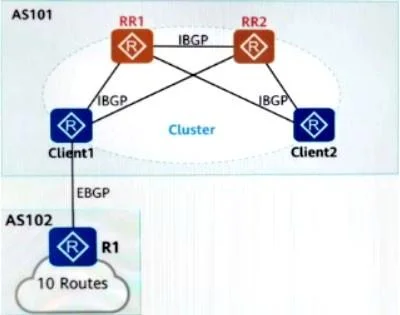
As shown in the figure, Client1 and Client2 serve as clients of RR1 and RR2 at the same time. RR1 and R2 are in the same Cluster, and R1 has introduced 10 routes. Assuming that BGP is configured…
The correct answer is C. 20. Option C (20) is correct because Client2 is a client of both RR1 and RR2 simultaneously. R1's 10 routes are reflected by RR1 to Client2 (10 entries) and independently reflected by RR2 to Client2 (another 10 entries), yielding 20 BGP table entries - two distinct paths for each…
Question
As shown in the figure, Client1 and Client2 serve as clients of RR1 and RR2 at the same time. RR1 and R2 are in the same Cluster, and R1 has introduced 10 routes. Assuming that BGP is configured correctly and neighbor relationships have been established, how many route entries are there in the BGP routing table of Client2?
Exhibit
Options
- A15
- B10
- C20
- D0
How the community answered
(53 responses)- A6% (3)
- B2% (1)
- C83% (44)
- D9% (5)
Explanation
Option C (20) is correct because Client2 is a client of both RR1 and RR2 simultaneously. R1's 10 routes are reflected by RR1 to Client2 (10 entries) and independently reflected by RR2 to Client2 (another 10 entries), yielding 20 BGP table entries - two distinct paths for each prefix, one via each Route Reflector.
Why the distractors are wrong:
- B (10) incorrectly assumes Client2 receives routes from only one RR, ignoring the dual-RR client relationship.
- A (15) has no topological basis; there is no mechanism here that would add a partial set of 5 extra routes.
- D (0) is wrong because BGP is explicitly stated to be correctly configured and neighbor relationships are established, so routes are successfully exchanged.
Memory tip: Think "clients × reflectors = table entries." When a client is dual-homed to two RRs in the same cluster, it receives the same N routes twice - once per RR - so multiply N by the number of RRs (10 × 2 = 20). The BGP table tracks each path separately, even to the same prefix.
Topics
Community Discussion
No community discussion yet for this question.