
H12-891_V1.0 · Question #120
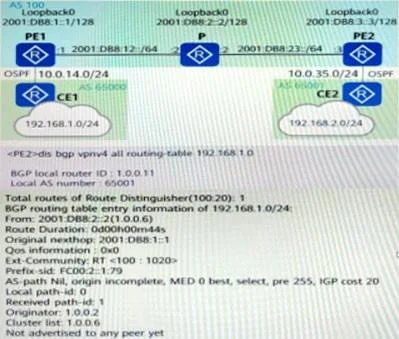
As shown in the figure, a certain L3VPN Over SRv6 BE network is used. According to the information displayed on PE2, which one of the following descriptions is wrong?
The correct answer is C. The Router-id of the BGP process of PE2 device is 1.0.0.6. Option C is incorrect because the BGP Router-ID shown in PE2's display output would correspond to PE2's own loopback address - not 1.0.0.6. In a typical SRv6 PE deployment, each device's Router-ID maps to its assigned loopback (e.g., PE2 might be 1.0.0.2 or similar), so 1.0.0.6…
Question
As shown in the figure, a certain L3VPN Over SRv6 BE network is used. According to the information displayed on PE2, which one of the following descriptions is wrong?
Exhibit
Options
- APE2 imported the route 192.168. 1. 0/24 through the import route command.
- BAn IBGP neighbor relationship is established between PE2 and PE1, and the route 192. 168. 1.
- CThe Router-id of the BGP process of PE2 device is 1.0.0.6
- DThe command type corresponding to FC00:2::1:79 is End. DT4
How the community answered
(38 responses)- A8% (3)
- B16% (6)
- C74% (28)
- D3% (1)
Explanation
Option C is incorrect because the BGP Router-ID shown in PE2's display output would correspond to PE2's own loopback address - not 1.0.0.6. In a typical SRv6 PE deployment, each device's Router-ID maps to its assigned loopback (e.g., PE2 might be 1.0.0.2 or similar), so 1.0.0.6 likely belongs to a different node in the topology.
Why the distractors are correct (and therefore not the answer):
- A is correct: The
import-routecommand is the standard way PEs redistribute local CE-facing prefixes (like 192.168.1.0/24) into the VPN routing table. - B is correct: PE1 and PE2 reside in the same AS, so they form an IBGP peer relationship to exchange VPN-labeled routes (MP-BGP with VPNv4/VPNv6).
- D is correct:
End.DT4is the SRv6 function for decapsulating an SRv6 packet and performing an IPv4 table lookup - exactly what a PE does to deliver L3VPN IPv4 traffic, making it the appropriate behavior for that SID.
Memory tip: For Router-ID questions, think "the ID belongs to the device it's on." If the displayed PE2 output shows a Router-ID, it must match PE2's own loopback - any foreign address is a red flag. Also remember: End.DT4 = Decap + v4 Table lookup (DT = "Decap Table").
Topics
Community Discussion
No community discussion yet for this question.