
H12-831_V1.0 · Question #80
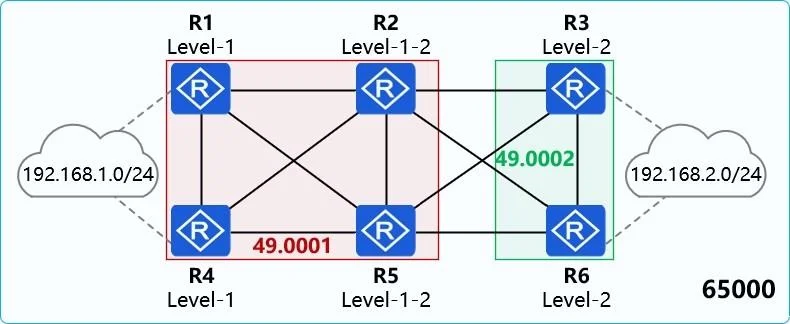
In the network shown in the figure, R1, R2, R4, and R5 run IS-IS in area 49.0001. R3 and R6 run IS-IS in area 49.0002. Configure "import-route isis level-2 into level-1" on R2 and R5. Inside…
The correct answer is A. There are two equal default routes in R4 routing table. B. There are two equal default routes in R1's routing table. D. R1 routing table has a routing entry for 192.168.2.0/24. See the full explanation below for the reasoning.
Question
In the network shown in the figure, R1, R2, R4, and R5 run IS-IS in area 49.0001. R3 and R6 run IS-IS in area 49.0002. Configure "import-route isis level-2 into level-1" on R2 and R5. Inside AS65000, R1, R3, R4, and R6 establish IBGP neighbor relationships with R2 and R5, of which R2 and R5 are RRs and R1, R4, R3, and R6 are clients. IBGP neighbor relationships are all established using the Loopback0 interface. The IP address of the Loopback0 interface of each device is 10.0.X.X/32, and the Router ID is 10.0.X.X, where X is the device number. R1 and R4 import the external network 192.168.1.0/24 into BGP, and R3 and R6 import the external network 192.168.2.0/24 into BGP. Which of the following descriptions are correct by default? (Multiple choice)
Exhibit
Options
- AThere are two equal default routes in R4 routing table.
- BThere are two equal default routes in R1's routing table.
- CThe route entry for 192.168.2.0/24 in R4's routing table has two different outbound interfaces
- DR1 routing table has a routing entry for 192.168.2.0/24
How the community answered
(18 responses)- A83% (15)
- C17% (3)
Community Discussion
No community discussion yet for this question.