
H12-811_V1.0 · Question #922
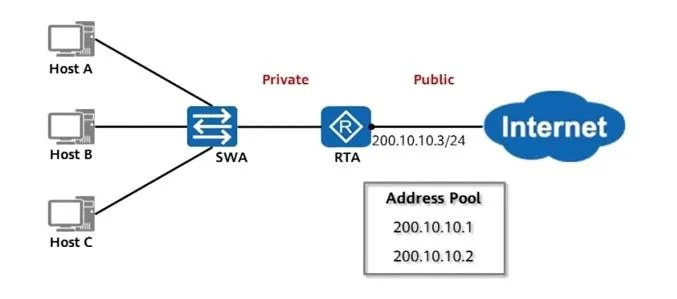
As shown in the figure, RTA uses NAT and has an address pool configured to implement many- to- many non-NAPT address translation, so that hosts on the private network can access the public network…
The correct answer is B. No public IP address is assigned to Host C, and Host C cannot access the public network. In a many-to-many non-NAPT (Network Address Port Translation) configuration, each private host requires a unique public IP address from the address pool. If only two public IP addresses are available and both are already in use by Host A and Host B, no IP will be available for…
Question
As shown in the figure, RTA uses NAT and has an address pool configured to implement many- to- many non-NAPT address translation, so that hosts on the private network can access the public network. Assume that the address pool has only two public IP addresses, which are translated for Host A and Host B. If Host C wants to access the public network, which of the following statements is true?
Exhibit
Options
- AAll hosts use public IP addresses in turn and can access the public network.
- BNo public IP address is assigned to Host C, and Host C cannot access the public network.
- CRTA performs NAT based on the source port number of Host C, and Host C can access the public
- DRTA assigns an interface address (200.10.10.3) to Host C, and Host C can access the public
How the community answered
(66 responses)- A3% (2)
- B76% (50)
- C9% (6)
- D12% (8)
Explanation
In a many-to-many non-NAPT (Network Address Port Translation) configuration, each private host requires a unique public IP address from the address pool. If only two public IP addresses are available and both are already in use by Host A and Host B, no IP will be available for Host C, preventing it from accessing the public network.
Topics
Community Discussion
No community discussion yet for this question.