
H12-725_V4.0 · Question #152
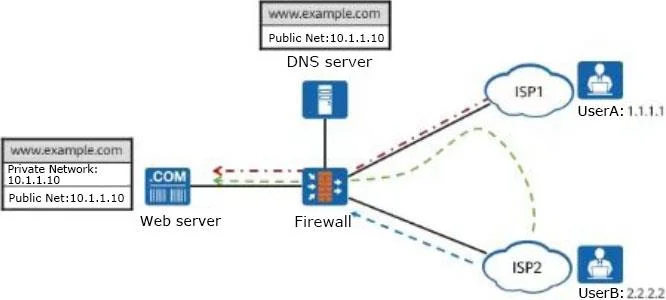
As shown in the figure, the scenario is that an external network user accesses an internal server. Which of the following descriptions of this scenario are correct? (Multiple choice)
The correct answer is B. ISP2 can access the web server through the ISP1 network D. ISP1 link may cause network congestion. B is correct because cross-ISP connectivity is technically possible - ISP2 users can route through ISP1's backbone to reach the web server. This is standard internet routing behavior, even if it's not the most efficient path. D is correct because when ISP2 users are forced to…
Question
As shown in the figure, the scenario is that an external network user accesses an internal server. Which of the following descriptions of this scenario are correct? (Multiple choice)
Exhibit
Options
- AThe address after the DNS resolution initiated by the ISP2 user is not in the same network
- BISP2 can access the web server through the ISP1 network
- CISP routing technology can be used to ensure that ISP2 users access the Web server through the
- DISP1 link may cause network congestion
How the community answered
(27 responses)- A11% (3)
- B81% (22)
- C7% (2)
Explanation
B is correct because cross-ISP connectivity is technically possible - ISP2 users can route through ISP1's backbone to reach the web server. This is standard internet routing behavior, even if it's not the most efficient path.
D is correct because when ISP2 users are forced to traverse the ISP1 link to reach the web server, that interconnection link becomes a bottleneck. Heavy cross-ISP traffic is a well-known cause of congestion, especially at ISP peering points.
A is wrong because with ISP-aware (intelligent) DNS, DNS resolution can return an IP address within the user's own ISP network - assuming the server has a presence on both networks. Saying the resolved address is never in the same network overstates the limitation.
C is wrong because ISP routing technology alone cannot guarantee that ISP2 users access the server through a specific link. Ensuring optimal cross-ISP path selection requires application-layer solutions like intelligent DNS or Global Server Load Balancing (GSLB), not just routing protocols.
Memory tip: B and D describe what actually happens in cross-ISP access (it works, but creates congestion). A and C are traps because they describe guarantees that don't hold - DNS isn't always cross-network (A), and routing can't enforce path control alone (C).
Topics
Community Discussion
No community discussion yet for this question.