
H12-721 · Question #138
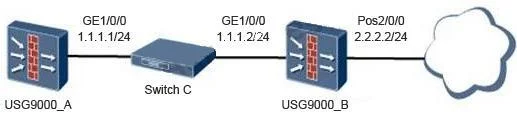
BFD static route topology is shown in Figure A. On the firewall, administrator needs to do the following configuration: [USG9000_A] bfd [USG9000_A-bfd] quit [USG9000_A] bfd aa bind peer-ip 1.1.1.2…
The correct answer is A. The command "bfd as bind peer-ip 1.1.1.2" is used to create BFD sessions to detect link status D. firewall on BFD session will also need to bind with a static route command. See the full explanation below for the reasoning.
Question
BFD static route topology is shown in Figure A. On the firewall, administrator needs to do the following configuration:
[USG9000_A] bfd [USG9000_A-bfd] quit [USG9000_A] bfd aa bind peer-ip 1.1.1.2 [USG9000_A-bfd-session-aa] discriminator local 10 [USG9000_A-bfd-session-aa] discriminator remote 20 [USG9000_A-bfd-session-aa] commit [USG9000_A-bfd-session-aa] quit Which of the following section of the configuration is correct there? (Choose two answers)
Exhibit
Options
- AThe command "bfd as bind peer-ip 1.1.1.2" is used to create BFD sessions to detect link status
- BThe command [U5G9000_A] bfd configuration errors, should be replaced by [U5G9000_A] bfd
- C[USG9000_A-bfd-session-aa] commit configuration is optional, if not configure the system will
- Dfirewall on BFD session will also need to bind with a static route command:
How the community answered
(32 responses)- A72% (23)
- B19% (6)
- C9% (3)
Community Discussion
No community discussion yet for this question.