
GSNA · Question #222
You work as an Exchange Administrator for XYZ CORP. The network design of the company is given below: Employees are required to use Microsoft Outlook Web Access to access their emails remotely. You…
The correct answer is C. Install two front-end Exchange 2000 servers. To ensure fault tolerance among the servers and to get the highest possible level of security and encryption for OWA clients, you must install two front-end Exchange 2000 servers. Place the new servers on the perimeter network and configure load balancing between them. To…
Question
You work as an Exchange Administrator for XYZ CORP. The network design of the company is given below:
Employees are required to use Microsoft Outlook Web Access to access their emails remotely. You are required to accomplish the following goals: Ensure fault tolerance amongst the servers. Ensure the highest level of security and encryption for the Outlook Web Access clients. What will you do to accomplish these goals?
Exhibit
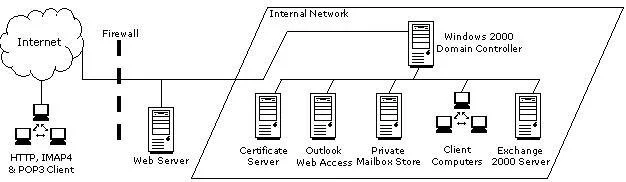
Options
- AInstall one front-end Exchange 2000 server and continue to run Microsoft Outlook Web Access on
- BInstall two front-end Exchange 2000 servers.
- CInstall two front-end Exchange 2000 servers.
- DInstall two Exchange 2000 servers.
How the community answered
(55 responses)- A4% (2)
- B9% (5)
- C71% (39)
- D16% (9)
Explanation
To ensure fault tolerance among the servers and to get the highest possible level of security and encryption for OWA clients, you must install two front-end Exchange 2000 servers. Place the new servers on the perimeter network and configure load balancing between them. To enhance security, you should also configure Certificate Services and create a rule on the firewall to redirect port 443 to the servers. The most secure firewall configuration is placing a firewall on either side of the front-end servers. This isolates the front-end servers in a perimeter network, commonly referred to as a demilitarized zone (DMZ). It is always better to configure more than one front-end server to get fault tolerance.
Topics
Community Discussion
No community discussion yet for this question.