
GCIH · Question #837
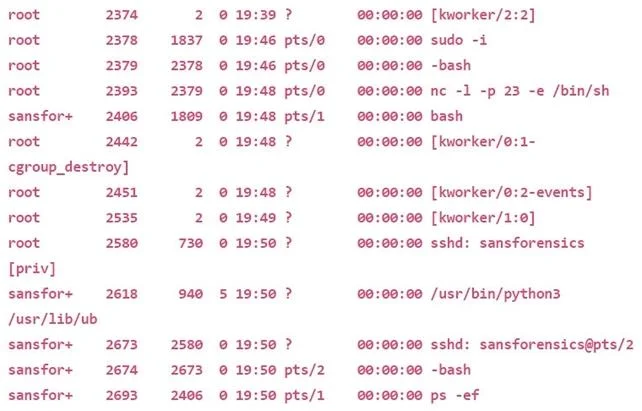
An organization has an SSH server that was compromised. Given the following evidence, what most likely occurred?
The correct answer is D. An attacker accessed the system through a backdoor using netcat. This question tests recognition of netcat as a backdoor tool commonly used by attackers after gaining initial access to a compromised SSH server.
Question
An organization has an SSH server that was compromised. Given the following evidence, what most likely occurred?
Exhibit
Options
- AThe kworker thread was exploited using process injection
- BThe SSH user account credentials have been compromised
- CAn attacker uploaded a malicious python library to a well-known repository
- DAn attacker accessed the system through a backdoor using netcat
How the community answered
(21 responses)- A5% (1)
- B10% (2)
- C19% (4)
- D67% (14)
Why each option
This question tests recognition of netcat as a backdoor tool commonly used by attackers after gaining initial access to a compromised SSH server.
Process injection into kworker threads is a kernel-level privilege escalation technique, not the primary mechanism for maintaining persistent remote access to a compromised SSH server.
Compromised SSH credentials would result in login events visible in auth logs via the SSH daemon itself, not evidence of a separate backdoor channel.
Uploading a malicious library to a public repository is a supply chain attack and would not directly explain a compromise of a specific SSH server.
Netcat (nc) is a well-known utility that attackers use to create persistent backdoors by binding a shell to a listening port, allowing remote command execution without using the SSH service itself. After compromising an SSH server, attackers frequently install a netcat listener as a secondary access method. This explains why the intrusion persists even if SSH credentials are reset.
Concept tested: Netcat backdoor persistence after SSH compromise
Source: https://attack.mitre.org/techniques/T1059/004/
Topics
Community Discussion
No community discussion yet for this question.