
GCIH · Question #424
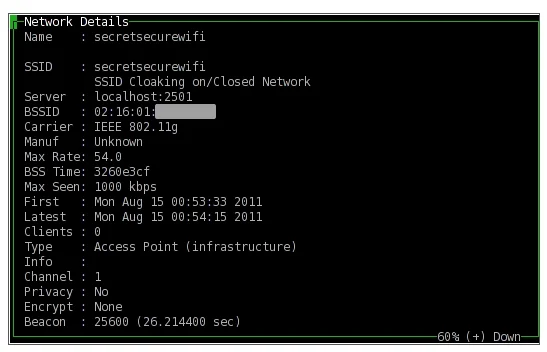
The screenshot from Kismet below shows details of a WiFi network with SSID Cloaking enabled. How was Kismet able to collect the SSID information?
The correct answer is C. A client successfully associated to the AP, transmitting the SSID in clear text. Association request packets are required to specify the SSID of the desired network. This information is sent in a clear text, so a passive WiFi scanning application such as Kismet can discover a cloaked SSID if a client associates to the network. Kismet indicates that SSID…
Question
The screenshot from Kismet below shows details of a WiFi network with SSID Cloaking enabled. How was Kismet able to collect the SSID information?
Exhibit
Options
- AKismet cracked the weak encryption and was able to decrypt the SSID
- BAn attacker gained administrative access to the AP, and disabled SSID cloaking
- CA client successfully associated to the AP, transmitting the SSID in clear text
- DThe AP provided the SSID in response to a beacon probe from the system running Kismet
How the community answered
(55 responses)- A15% (8)
- B9% (5)
- C73% (40)
- D4% (2)
Explanation
Association request packets are required to specify the SSID of the desired network. This information is sent in a clear text, so a passive WiFi scanning application such as Kismet can discover a cloaked SSID if a client associates to the network. Kismet indicates that SSID cloaking is still active for this network, so it has been disabled. WEP encryption is not enabled on this network, as indicated by the Privacy and Encrypt lines in Kismet identifies SSIDs corresponding to unique BSSIDs, so this SSID was not erroneously identified from a nearby network.
Topics
Community Discussion
No community discussion yet for this question.