
GCIA · Question #99
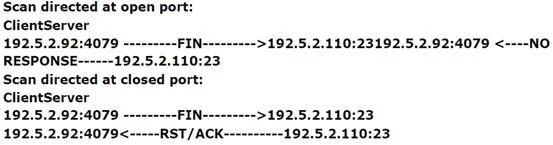
Adam, a malicious hacker is running a scan. Statistics of the scan is as follows: Which of the following types of port scan is Adam running?
The correct answer is D. FIN scan. A FIN scan sends TCP packets with only the FIN flag set to probe port status, exploiting RFC 793 behavior where closed ports respond with RST and open ports silently drop the packet.
Question
Adam, a malicious hacker is running a scan. Statistics of the scan is as follows:
Which of the following types of port scan is Adam running?
Exhibit
Options
- AXMAS scan
- BACK scan
- CIdle scan
- DFIN scan
How the community answered
(52 responses)- A2% (1)
- B6% (3)
- C13% (7)
- D79% (41)
Why each option
A FIN scan sends TCP packets with only the FIN flag set to probe port status, exploiting RFC 793 behavior where closed ports respond with RST and open ports silently drop the packet.
An XMAS scan sets the FIN, PSH, and URG flags simultaneously (lighting up the packet 'like a Christmas tree'), which is a different flag combination from a FIN-only scan.
An ACK scan sends packets with only the ACK flag to map firewall rulesets by determining whether ports are filtered or unfiltered, not to identify open vs. closed ports.
An idle scan is an advanced technique that uses a third-party 'zombie' host's IP ID sequence to stealthily probe a target, which is fundamentally different from a simple FIN-flagged packet scan.
A FIN scan works by sending a TCP segment with only the FIN flag set to a target port. Per RFC 793, a closed port must respond with a RST/ACK packet, while an open port will silently discard the unexpected FIN. This asymmetric response allows the scanner to distinguish open from closed ports without completing a full TCP handshake, making it stealthier than a SYN scan.
Concept tested: TCP FIN scan port scanning technique
Source: https://nmap.org/book/man-port-scanning-techniques.html
Topics
Community Discussion
No community discussion yet for this question.