
FCSS_EFW_AD-7.6 · Question #39
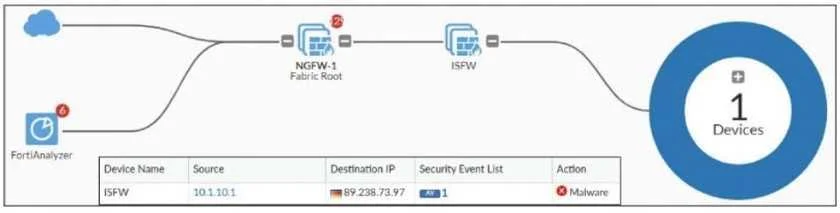
Refer to the exhibit, which shows a physical topology and a traffic log. The administrator is checking on FortiAnalyzer traffic from the device with IP address 10.1.10.1, located behind the…
The correct answer is B. ISFW is in a Security Fabric environment. D. The firewall policy in NGFW-1 has UTM enabled. From the exhibit, ISFW is part of a Security Fabric environment with NGFW-1 as the Fabric Root. In this architecture, FortiGate devices share security intelligence, including logs and detected ISFW is in a Security Fabric environment: Security Fabric allows devices like ISFW to…
Question
Refer to the exhibit, which shows a physical topology and a traffic log. The administrator is checking on FortiAnalyzer traffic from the device with IP address 10.1.10.1, located behind the FortiGate ISFW device. The firewall policy in on the ISFW device does not have UTM enabled and the administrator is surprised to see a log with the action Malware, as shown in the exhibit. What are the two reasons FortiAnalyzer would display this log? (Choose two.)
Exhibit
Options
- ASecurity rating is enabled in ISFW.
- BISFW is in a Security Fabric environment.
- CISFW is not connected to FortiAnalyzer and must go through NGFW-1.
- DThe firewall policy in NGFW-1 has UTM enabled.
How the community answered
(35 responses)- A14% (5)
- B49% (17)
- C37% (13)
Explanation
From the exhibit, ISFW is part of a Security Fabric environment with NGFW-1 as the Fabric Root. In this architecture, FortiGate devices share security intelligence, including logs and detected ISFW is in a Security Fabric environment: Security Fabric allows devices like ISFW to receive threat intelligence from NGFW-1, even if UTM is not enabled locally. If NGFW-1 detects malware from IP 10.1.10.1 to 89.238.73.97, this information can be propagated to ISFW and FortiAnalyzer. The firewall policy in NGFW-1 has UTM enabled: Even though ISFW does not have UTM enabled, NGFW-1 (which sits between ISFW and the external network) does have UTM enabled and is scanning traffic. Since NGFW-1 detects malware in the session, it logs the event, which is then sent to FortiAnalyzer.
Topics
Community Discussion
No community discussion yet for this question.