
FCSS_EFW_AD-7.6 · Question #1
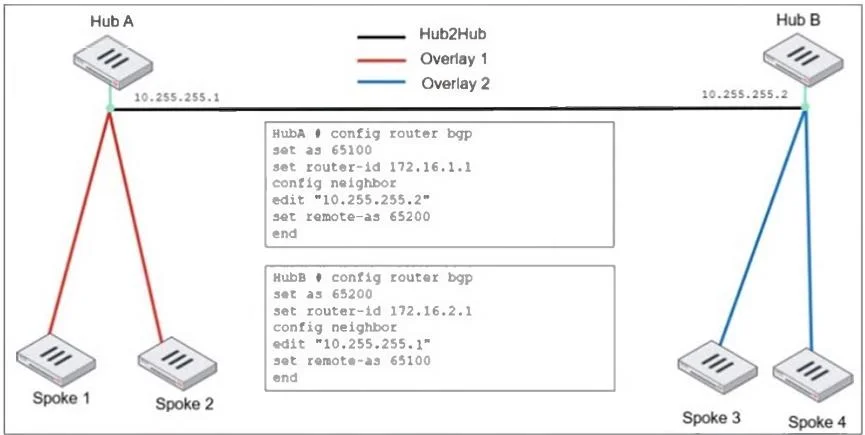
Refer to the exhibit, which shows an ADVPN network. An administrator must configure an ADVPN using IBGP and EBGP to connect overlay network 1 with 2. What two options must the administrator…
The correct answer is A. set ebgp-enforce-multrhop enable B. set next-hop-self enable. In this ADVPN (Auto-Discovery VPN) network, there are two hubs (Hub A and Hub B) connected via EBGP, while IBGP is used within each overlay. To ensure proper BGP routing between the overlays, the administrator must configure specific BGP options.. set ebgp-enforce-multihop…
Question
Refer to the exhibit, which shows an ADVPN network. An administrator must configure an ADVPN using IBGP and EBGP to connect overlay network 1 with 2. What two options must the administrator configure in BGP? (Choose two.)
Exhibit
Options
- Aset ebgp-enforce-multrhop enable
- Bset next-hop-self enable
- Cset ibgp-enforce-multihop advpn
- Dset attribute-unchanged next-hop
How the community answered
(36 responses)- A58% (21)
- C11% (4)
- D31% (11)
Explanation
In this ADVPN (Auto-Discovery VPN) network, there are two hubs (Hub A and Hub B) connected via EBGP, while IBGP is used within each overlay. To ensure proper BGP routing between the overlays, the administrator must configure specific BGP options.. set ebgp-enforce-multihop enable By default, EBGP requires directly connected neighbors. Since Hub A and Hub B are not directly connected but reach each other over an IPsec tunnel, multihop must be enabled for EBGP sessions to work. set next-hop-self enable In IBGP, the next-hop attribute does not change by default. When an IBGP route is advertised from a spoke to another hub or spoke, the next-hop needs to be updated to ensure proper reachability. Enabling next-hop-self forces the BGP speaker to advertise itself as the next-hop, ensuring that all spokes properly reach routes across the overlays.
Topics
Community Discussion
No community discussion yet for this question.