
FCSS_EFW_AD-7.4 · Question #31
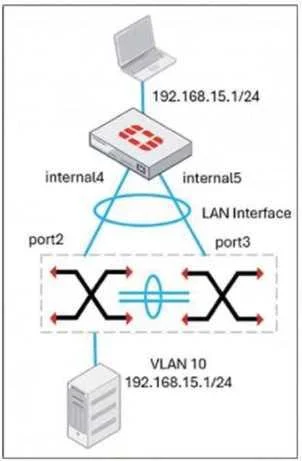
Refer to the exhibit, which shows a LAN interface connected from FortiGate to two FortiSwitch devices. What two conclusions can you draw from the corresponding LAN interface? (Choose two.)
The correct answer is B. The LAN interface must use a 802.3ad type interface. C. This connection is using a FortiLInk to manage VLANs on FortiGate. The diagram shows a FortiGate connected to two FortiSwitches, which suggests the use of FortiLink, Fortinet's protocol for managing switches directly from a FortiGate. Since multiple connections are being used, the LAN interface must be set to 802.3ad (LAG) mode to aggregate…
Question
Refer to the exhibit, which shows a LAN interface connected from FortiGate to two FortiSwitch devices. What two conclusions can you draw from the corresponding LAN interface? (Choose two.)
Exhibit
Options
- AYou must enable STP or RSTP on FortiGate and FortiSwitch to avoid layer 2 loopbacks.
- BThe LAN interface must use a 802.3ad type interface.
- CThis connection is using a FortiLInk to manage VLANs on FortiGate.
- DFortiGate is using an SD-WAN-type interface to connect to a FortiSwitch device with MCLAG.
How the community answered
(29 responses)- A17% (5)
- B76% (22)
- D7% (2)
Explanation
The diagram shows a FortiGate connected to two FortiSwitches, which suggests the use of FortiLink, Fortinet's protocol for managing switches directly from a FortiGate. Since multiple connections are being used, the LAN interface must be set to 802.3ad (LAG) mode to aggregate the links for redundancy and load balancing. This setup allows FortiGate to handle VLAN assignments dynamically, as seen with VLAN 10 (192.168.15.1/24). FortiLink ensures seamless integration between FortiGate and FortiSwitches, making STP unnecessary because Fortinet's MCLAG prevents loops at Layer 2. SD-WAN, on the other hand, is used for WAN interfaces and does not apply to switch connectivity in this scenario.
Topics
Community Discussion
No community discussion yet for this question.