
FCSS_EFW_AD-7.4 · Question #2
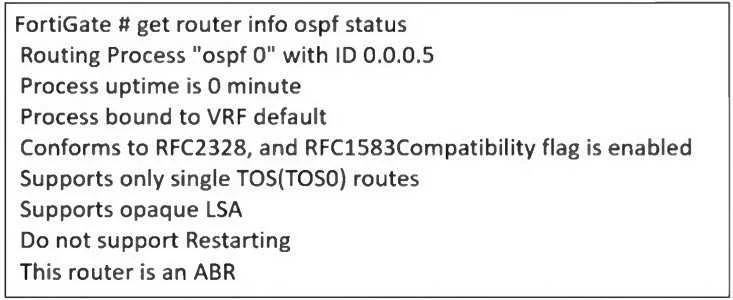
Refer to the exhibit, which contains the partial output of an OSPF command. An administrator is checking the OSPF status of a FortiGate device and receives the output shown in the exhibit. What two…
The correct answer is B. The FortiGate device is connected to multiple areas C. The FortiGate device injects external routing information. The output of the get router info ospf status command provides key information about the OSPF (Open Shortest Path First) configuration on the FortiGate device. The FortiGate device is connected to multiple areas The output states: "This router is an ABR" ABR (Area Border…
Question
Refer to the exhibit, which contains the partial output of an OSPF command. An administrator is checking the OSPF status of a FortiGate device and receives the output shown in the exhibit. What two conclusions can the administrator draw? (Choose two.)
Exhibit
Options
- AThe FortiGate device is a backup designated router
- BThe FortiGate device is connected to multiple areas
- CThe FortiGate device injects external routing information
- DThe FortiGate device has OSPF ECMP enabled
How the community answered
(34 responses)- A12% (4)
- B82% (28)
- D6% (2)
Explanation
The output of the get router info ospf status command provides key information about the OSPF (Open Shortest Path First) configuration on the FortiGate device. The FortiGate device is connected to multiple areas The output states: "This router is an ABR" ABR (Area Border Router) means the device is connected to multiple OSPF areas and maintains routing information between them. This confirms that the FortiGate is not just in one area, but at least one backbone area (Area 0) and another OSPF area. The FortiGate device injects external routing information The output states: "Supports opaque LSA" Opaque LSAs (Type 9, 10, and 11) are used in OSPF extensions, including those that support external route injection. Typically, ABRs or ASBRs (Autonomous System Boundary Routers) inject external routes, allowing routes from other routing protocols (such as BGP or static routes) to be advertised into
Topics
Community Discussion
No community discussion yet for this question.