
FCSS_EFW_AD-7.4 · Question #16
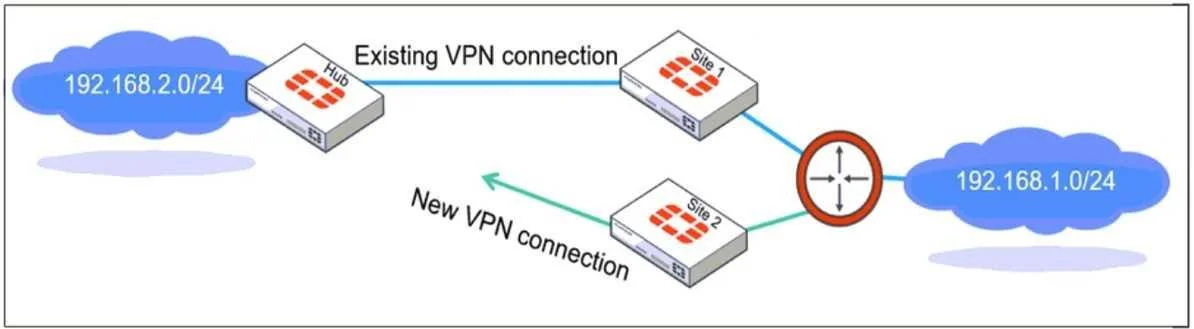
Refer to the exhibit, which shows a network diagram showing the addition of site 2 with an overlapping network segment to the existing VPN IPsec connection between the hub and site 1. Which IPsec…
The correct answer is A. Set route-overlap to either use-new or use-old. When multiple remote sites connect to the same hub using overlapping subnets, FortiGate needs to determine which route should be used for traffic forwarding. The route-overlap setting in IPsec Phase 2 allows FortiGate to handle this scenario by deciding whether to keep the…
Question
Refer to the exhibit, which shows a network diagram showing the addition of site 2 with an overlapping network segment to the existing VPN IPsec connection between the hub and site 1. Which IPsec phase 2 configuration must an administrator make on the FortiGate hub to enable equal-cost multi-path (ECMP) routing when multiple remote sites connect with overlapping subnets?
Exhibit
Options
- ASet route-overlap to either use-new or use-old
- BSet net-device to ecmp
- CSet single-source to enable
- DSet route-overlap to allow
How the community answered
(27 responses)- A78% (21)
- B11% (3)
- C4% (1)
- D7% (2)
Explanation
When multiple remote sites connect to the same hub using overlapping subnets, FortiGate needs to determine which route should be used for traffic forwarding. The route-overlap setting in IPsec Phase 2 allows FortiGate to handle this scenario by deciding whether to keep the existing route (use-old) or replace it with a new route (use-new). In an ECMP (Equal-Cost Multi-Path) routing setup, both routes should be retained and balanced, but FortiGate does not support ECMP directly over overlapping routes in IPsec Phase 2. Instead, an administrator must decide which connection takes precedence using route-overlap settings.
Topics
Community Discussion
No community discussion yet for this question.