
FCSS_CDS_AR-7.6 · Question #50
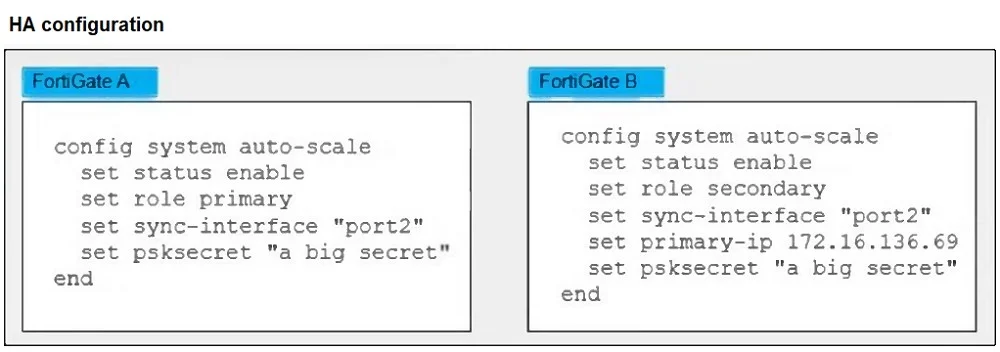
Refer to the exhibit. An administrator deployed an HA active-active load balance sandwich in Microsoft Azure. The setup requires configuration synchronization between devices. What can you conclude…
The correct answer is B. By default, FortiGate uses FGCP. C. It does not synchronize the FortiGate hostname. By default, FortiGate uses FGCP (FortiGate Clustering Protocol) for synchronization and HA operations, which applies here. In an auto-scale/load-balance sandwich setup, only configuration synchronization for supported objects occurs; system-specific settings like the hostname…
Question
Refer to the exhibit. An administrator deployed an HA active-active load balance sandwich in Microsoft Azure. The setup requires configuration synchronization between devices. What can you conclude from the configured settings shown in the exhibit? (Choose two.)
Exhibit
Options
- AFortiGate A and FortiGate B are two independent devices.
- BBy default, FortiGate uses FGCP.
- CIt does not synchronize the FortiGate hostname.
- DFortiGate-VM instances are scaled out automatically according to predefined workload levels.
How the community answered
(47 responses)- A19% (9)
- B70% (33)
- D11% (5)
Explanation
By default, FortiGate uses FGCP (FortiGate Clustering Protocol) for synchronization and HA operations, which applies here. In an auto-scale/load-balance sandwich setup, only configuration synchronization for supported objects occurs; system-specific settings like the hostname are not synchronized.
Topics
Community Discussion
No community discussion yet for this question.