
FCP_FGT_AD-7.4 · Question #30
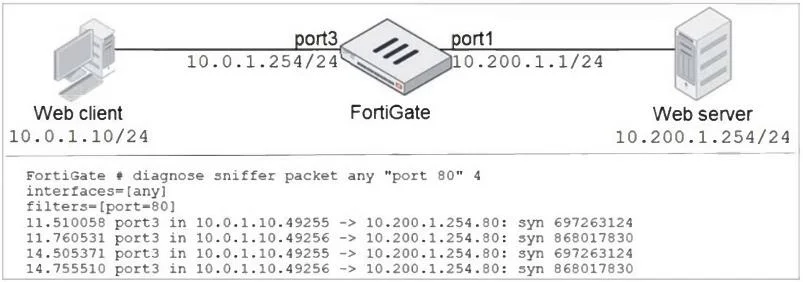
Refer to the exhibit. In the network shown in the exhibit, the web client cannot connect to the HTTP web server. The administrator runs the FortiGate built-in sniffer and gets the output shown in…
The correct answer is A. Execute a debug flow. The sniffer output shows that packets from the web client are reaching the FortiGate and being forwarded to the web server, but there is no indication that the web server is responding. To troubleshoot this issue, executing a debug flow will help analyze the traffic path and…
Question
Refer to the exhibit. In the network shown in the exhibit, the web client cannot connect to the HTTP web server. The administrator runs the FortiGate built-in sniffer and gets the output shown in the exhibit. What should the administrator do next, to troubleshoot the problem?
Exhibit
Options
- AExecute a debug flow.
- BCapture the traffic using an external sniffer connected to port1.
- CExecute another sniffer on FortiGate, this time with the filter "host 10.0.1.10".
- DRun a sniffer on the web server.
How the community answered
(61 responses)- A77% (47)
- B7% (4)
- C13% (8)
- D3% (2)
Explanation
The sniffer output shows that packets from the web client are reaching the FortiGate and being forwarded to the web server, but there is no indication that the web server is responding. To troubleshoot this issue, executing a debug flow will help analyze the traffic path and pinpoint where the problem might be occurring, such as a possible issue in firewall policy or route settings that is causing the server not to respond correctly.
Topics
Community Discussion
No community discussion yet for this question.