E10-001 · Question #140
What is an advantage of sub-LUN tiering?
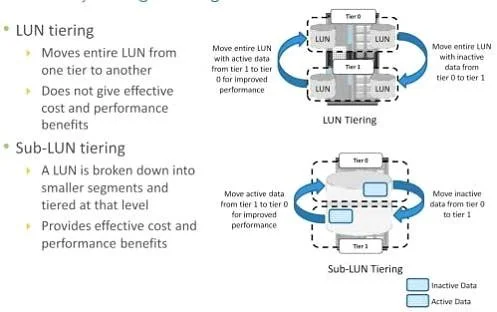
The correct answer is A. Improved performance. Intra-array Storage Tiering The process of storage tiering within a storage array is called intra-array storage tiering. It enables the efficient use of SSD, FC, and SATA drives within an array and provides performance and cost optimization. The goal is to keep the SSDs busy by…
Question
What is an advantage of sub-LUN tiering?
Exhibit
Options
- AImproved performance
- BEnhanced reliability and availability
- CDynamic expansion of storage capacity
- DFaster provisioning of thin LUNs
How the community answered
(24 responses)- A75% (18)
- B4% (1)
- C17% (4)
- D4% (1)
Explanation
Intra-array Storage Tiering The process of storage tiering within a storage array is called intra-array storage tiering. It enables the efficient use of SSD, FC, and SATA drives within an array and provides performance and cost optimization. The goal is to keep the SSDs busy by storing the most frequently accessed data on them, while moving out the less frequently accessed data to the SATA drives. Data movements executed between tiers can be performed at the LUN level or at the sub-LUN level. The performance can be further improved by implementing tiered cache. Traditionally, storage tiering is operated at the LUN level that moves an entire LUN from one tier of storage to another. This movement includes both active and inactive data in that LUN. This method does not give effective cost and performance benefits. Today, storage tiering can be implemented at the sub-LUN level. In sub-LUN level tiering, a LUN is broken down into smaller segments and tiered at that level. Movement of data with much finer granularity, for example 8 MB, greatly enhances the value proposition of automated storage tiering. Tiering at the sub-LUN level effectively moves active data to faster drives and less active data to slower drives.
Topics
Community Discussion
No community discussion yet for this question.
