E10-001 · Question #103
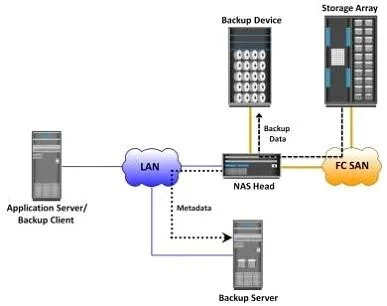
Which NAS backup environment uses a NAS head to retrieve data from storage over a SAN and then sends the data directly to the backup device?
The correct answer is C. NDMP two-way. NDMP is an industry-standard TCP/IP-based protocol specifically designed for a backup in a NAS environment. It communicates with several elements in the backup environment (NAS head, backup devices, backup server, and so on) for data transfer and enables vendors to use a common…
Question
Which NAS backup environment uses a NAS head to retrieve data from storage over a SAN and then sends the data directly to the backup device?
Exhibit
Options
- AServerless
- BNDMP three-way
- CNDMP two-way
- DServer-based
How the community answered
(35 responses)- A14% (5)
- B9% (3)
- C74% (26)
- D3% (1)
Explanation
NDMP is an industry-standard TCP/IP-based protocol specifically designed for a backup in a NAS environment. It communicates with several elements in the backup environment (NAS head, backup devices, backup server, and so on) for data transfer and enables vendors to use a common protocol for the backup architecture. Data can be backed up using NDMP regardless of the operating system or platform. Due to its flexibility, it is no longer necessary to transport data through the application server, which reduces the load on the application server and improves the backup speed. NDMP optimizes backup and restore by leveraging the high-speed connection between the backup devices and the NAS head. In NDMP, backup data is sent directly from the NAS head to the backup device, whereas metadata is sent to the backup server. Figure on the slide illustrates backup in the NAS environment using NDMP 2-way. In this model, network traffic is minimized by isolating data movement from the NAS head to the locally attached backup device. Only metadata is transported on the network. The backup device is dedicated to the NAS device, and hence, this method does not support centralized management of all backup
Topics
Community Discussion
No community discussion yet for this question.
