
DP-600 · Question #93
Note: This question is part of a series of questions that present the same scenario. Each question in the series contains a unique solution that might meet the stated goals. Some question sets might…
The correct answer is B. No. The proposed solution replaces a slow condition with ISEMPTY(RELATEDTABLE('Order Item')). While ISEMPTY is generally efficient (it short-circuits at the first row found), it checks whether a related table is empty - i.e., it returns TRUE when there are NO related rows. This is…
Question
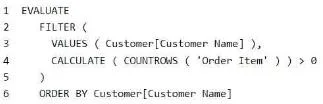
Note: This question is part of a series of questions that present the same scenario. Each question in the series contains a unique solution that might meet the stated goals. Some question sets might have more than one correct solution, while others might not have a correct solution. After you answer a question in this section, you will NOT be able to return to it. As a result, these questions will not appear in the review screen. You have a Fabric tenant that contains a semantic model named Model1. You discover that the following query performs slowly against Model1. You need to reduce the execution time of the query. Solution: You replace line 4 by using the following code:
ISEMPTY ( RELATEDTABLE ( 'Order Item' ) ) Does this meet the goal?
Exhibit
Options
- AYes
- BNo
How the community answered
(18 responses)- A44% (8)
- B56% (10)
Explanation
The proposed solution replaces a slow condition with ISEMPTY(RELATEDTABLE('Order Item')). While ISEMPTY is generally efficient (it short-circuits at the first row found), it checks whether a related table is empty - i.e., it returns TRUE when there are NO related rows. This is the logical inverse of checking for the presence of related rows. If the original query's intent was to find customers WITH orders, this replacement inverts the logic entirely, producing wrong results - not just slower ones. Beyond the logic error, ISEMPTY(RELATEDTABLE(...)) still requires evaluating the related table context for every row and does not leverage any optimization that would measurably reduce execution time compared to a well-written COUNTROWS approach.
Topics
Community Discussion
No community discussion yet for this question.