
DP-600 · Question #202
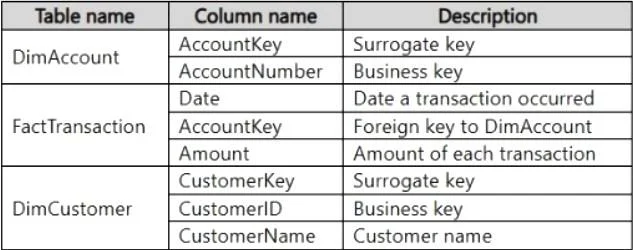
You have a semantic model named Model1 that contains data that relates to customers and their bank account balances. Model1 has the following tables and columns. A customer can have one or more…
The correct answer is B. a bridge table with relationships to DimCustomer and DimAccount. We need to define a many-to-many relation between DimAccount and DimCustomer. This can be done using a bridge table. Note: Relate many-to-many dimensions The classic many-to-many scenario relates two entities, for example bank customers and bank accounts. Consider that…
Question
You have a semantic model named Model1 that contains data that relates to customers and their bank account balances. Model1 has the following tables and columns. A customer can have one or more accounts. Each account can be associated to multiple customers. You need to ensure that users can query Model1 to identify the total transaction amounts by customer. What should you add to Model1?
Exhibit
Options
- Aa many-to-many relationship between FactTransaction and Dim Customer
- Ba bridge table with relationships to DimCustomer and DimAccount
- Ca bridge table with relationships to FactTransaction and DimCustomer
- Dthe CustomerKey column in FactTransaction and a relationship to DimCustomer
How the community answered
(57 responses)- A12% (7)
- B77% (44)
- C4% (2)
- D7% (4)
Explanation
We need to define a many-to-many relation between DimAccount and DimCustomer. This can be done using a bridge table. Note: Relate many-to-many dimensions The classic many-to-many scenario relates two entities, for example bank customers and bank accounts. Consider that customers can have multiple accounts, and accounts can have multiple customers. When an account has multiple customers, they're commonly called joint account Modeling these entities is straight forward. One dimension table stores accounts, and another dimension table stores customers. As is characteristic of dimension tables, there's a unique identifier (ID) column in each table. To model the relationship between the two tables, a third table is required. This table is commonly referred to as a bridging table. In this example, it's purpose is to store one row for each customer-account association. https://learn.microsoft.com/en-us/power-bi/guidance/relationships-many-to-many
Topics
Community Discussion
No community discussion yet for this question.