
DP-300 · Question #390
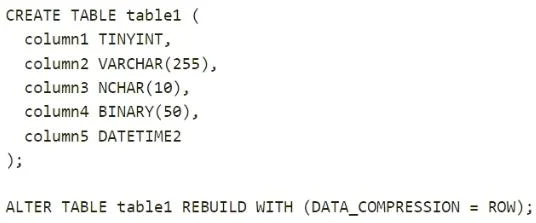
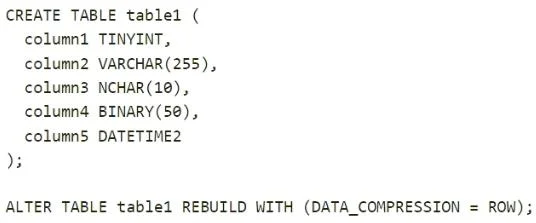
Hotspot Question You have an Azure subscription that contains an Azure SQL database named DB1. You execute the following T-SQL statements against DB1. For each of the following statements, select…
The correct answer is All the fields in column3 will occupy 10 bytes on disk. = No; Dictionary compression will be used to reduce the size of table1 on disk. = Yes; The data types stored in column1, column2, and column4 support compression. = No. The table uses PAGE compression (COMPRESSION = PAGE), which includes both ROW compression and DICTIONARY compression. Dictionary compression is a key component of PAGE compression that stores repeated values in a dictionary and replaces them with shorter codes, so the second…
Question
Exhibits
Answer Area
- All the fields in column3 will occupy 10 bytes on disk.No
- Dictionary compression will be used to reduce the size of table1 on disk.Yes
- The data types stored in column1, column2, and column4 support compression.No
Explanation
The table uses PAGE compression (COMPRESSION = PAGE), which includes both ROW compression and DICTIONARY compression. Dictionary compression is a key component of PAGE compression that stores repeated values in a dictionary and replaces them with shorter codes, so the second statement is correctly marked 'Yes'. Column3 is defined as CHAR(10), but with ROW compression (part of PAGE compression), fixed-length columns are stored using variable-length storage, meaning fields with shorter actual values will NOT necessarily occupy the full 10 bytes - they occupy only what is needed, so the first statement is correctly 'No'. Regarding the third statement, data types like TEXT, NTEXT, IMAGE, SQL_VARIANT, XML, and some large object types do NOT support compression; without seeing the exact T-SQL, column1 (likely int/bigint), column2 (likely varchar/nvarchar), and column4 (likely a LOB or unsupported type) - if column4 is a type like XML or sql_variant, it would not support compression, making the statement 'No' correct.
Topics
Community Discussion
No community discussion yet for this question.