
DP-300 · Question #282
Drag and Drop Question You have an Azure key vault named Vault1 and a SQL server on Azure Virtual Machines instance named SQL1. SQL1 hosts a database named DB1. You need to configure Transparent…
The correct answer is Create an Azure AD service principal and grant the service principal permissions for Vault1.; On SQL1, create an asymmetric key.; On SQL1, create a cryptographic provider and a Microsoft SQL Server credential.; On SQL1, create a login from the asymmetric key. To configure TDE on a SQL Server VM using Azure Key Vault, you must first create an Azure AD service principal and grant it permissions to Vault1 so SQL Server can authenticate to the vault. Next, you configure SQL1 with a cryptographic provider (using the SQL Server Connector…
Question
Exhibit
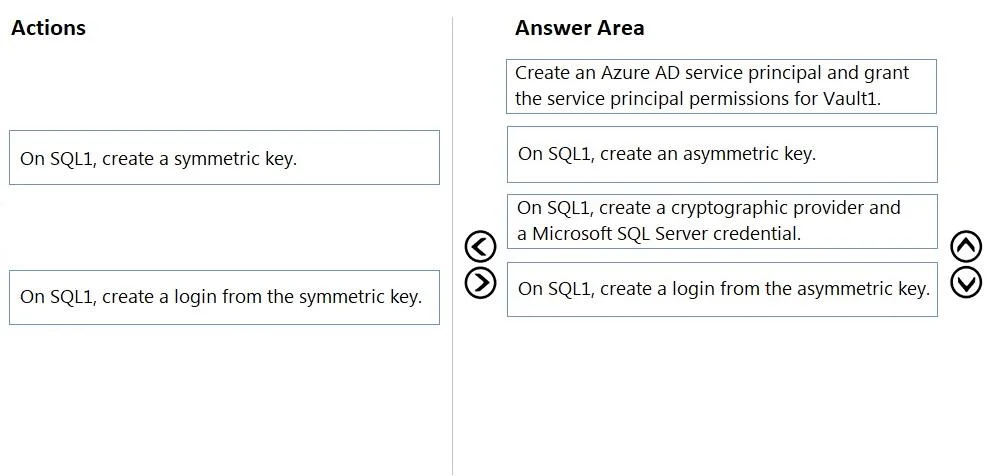
Answer Area
Drag items
Correct arrangement
- Create an Azure AD service principal and grant the service principal permissions for Vault1.
- On SQL1, create an asymmetric key.
- On SQL1, create a cryptographic provider and a Microsoft SQL Server credential.
- On SQL1, create a login from the asymmetric key.
Explanation
To configure TDE on a SQL Server VM using Azure Key Vault, you must first create an Azure AD service principal and grant it permissions to Vault1 so SQL Server can authenticate to the vault. Next, you configure SQL1 with a cryptographic provider (using the SQL Server Connector for Azure Key Vault) and a credential that uses the service principal's credentials. Then you create an asymmetric key in SQL Server that references the key stored in Vault1, followed by creating a login from that asymmetric key, which is then used to enable TDE on DB1. This sequence follows the official Microsoft EKM (Extensible Key Management) pattern for SQL Server on Azure VMs.
Topics
Community Discussion
No community discussion yet for this question.