
DP-300 · Question #200
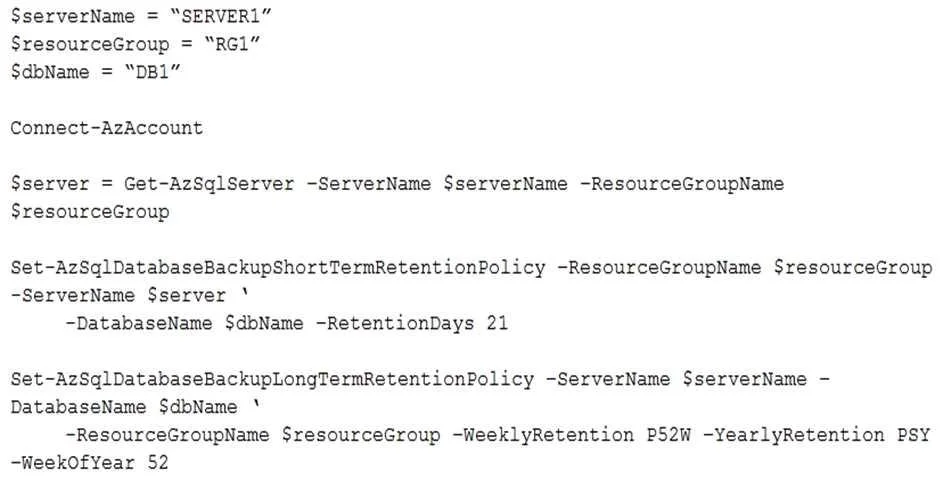
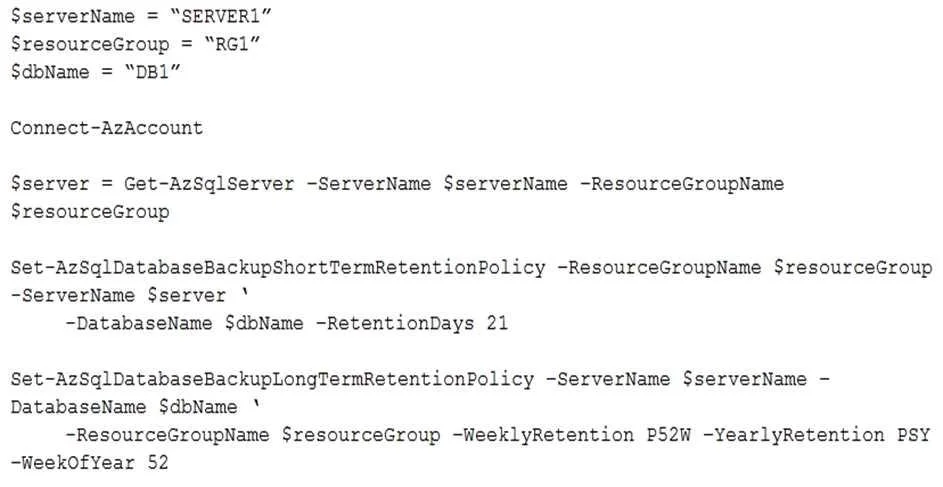
Hotspot Question You have an Azure SQL database. You run the following PowerShell script. For each of the following statements, select Yes if the statement is true. Otherwise, select No. NOTE: Each…
The correct answer is DB1 can be restored to a specific point in time 30 days ago. = Yes; DB1 can be restored from a weekly backup performed six months ago. = No; DB1 can be restored from a yearly backup performed six years ago. = No. The PowerShell script sets the BackupRetentionDays to 30, meaning point-in-time restore (PITR) is available for the past 30 days, making the first statement correct. Azure SQL Database's long-term retention (LTR) policy must be explicitly configured for weekly, monthly, or…
Question
Exhibits
Answer Area
- DB1 can be restored to a specific point in time 30 days ago.Yes
- DB1 can be restored from a weekly backup performed six months ago.No
- DB1 can be restored from a yearly backup performed six years ago.No
Explanation
The PowerShell script sets the BackupRetentionDays to 30, meaning point-in-time restore (PITR) is available for the past 30 days, making the first statement correct. Azure SQL Database's long-term retention (LTR) policy must be explicitly configured for weekly, monthly, or yearly backups beyond the PITR window - since the script only sets a 30-day retention period without configuring LTR, weekly backups from six months ago and yearly backups from six years ago are not available. Without an explicit LTR policy enabling weekly retention for 6+ months or yearly retention for 6+ years, those backup types simply do not exist for this database.
Topics
Community Discussion
No community discussion yet for this question.