
DP-100 · Question #540
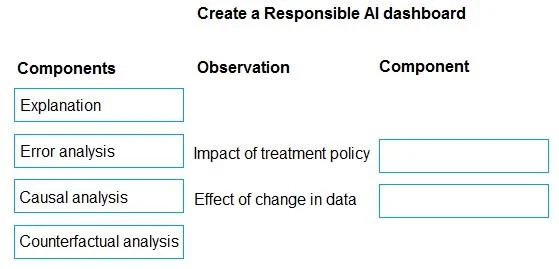
Drag and Drop Question You build and manage a model by using Azure Machine Learning workspace. Before you deploy the model, you must create a Responsible AI dashboard in Azure Machine Learning…
The correct answer is Causal analysis; Counterfactual analysis. This drag-and-drop question tests the ability to correctly identify and map Responsible AI dashboard components in Azure Machine Learning to their corresponding observations related to model impact and interpretability.
Question
Exhibit
Answer Area
Drag items
Correct arrangement
- Causal analysis
- Counterfactual analysis
Explanation
This drag-and-drop question tests the ability to correctly identify and map Responsible AI dashboard components in Azure Machine Learning to their corresponding observations related to model impact and interpretability.
Approach. The question asks to match Responsible AI dashboard components to specific observations.
-
'Impact of treatment policy': The scenario describes 'metrics that show real-world impact on an outcome of interest due to taking a treatment policy'. This directly aligns with the purpose of Causal analysis. Causal analysis in Responsible AI helps quantify the impact of a treatment or intervention (like a policy change) on an outcome, providing insights into 'what would happen if we do X'. Therefore, 'Causal analysis' should be dragged to 'Impact of treatment policy'.
-
'Effect of change in data': The scenario describes 'examples with minimal changes to a particular data point such that the model's prediction changes'. This is the definition of a counterfactual explanation. Counterfactual analysis helps understand how specific feature changes would alter a model's prediction, answering 'what is the smallest change to inputs that would flip the prediction?'. Therefore, 'Counterfactual analysis' should be dragged to 'Effect of change in data'.
Common mistakes.
- common_mistake. 1. Dragging 'Explanation' to either observation: The 'Explanation' component primarily focuses on overall model feature importance and individual prediction explanations (e.g., using SHAP values), showing why a model made a specific prediction. It does not specifically focus on the impact of a 'treatment policy' (causal effects) or the 'minimal changes to a data point' to flip a prediction (counterfactuals).
- Dragging 'Error analysis' to either observation: 'Error analysis' identifies cohorts of data points for which the model performs poorly. It focuses on model robustness and identifying performance issues, not on causal inference or counterfactual explanations.
- Swapping 'Causal analysis' and 'Counterfactual analysis': A common mistake would be confusing the two. 'Causal analysis' is about the 'why' (cause-and-effect of interventions/policies), while 'Counterfactual analysis' is about the 'what if' (minimal changes to alter prediction).
Concept tested. Responsible AI dashboard components in Azure Machine Learning, specifically understanding the purpose and application of Causal analysis and Counterfactual analysis for model interpretability and impact assessment.
Reference. null
Topics
Community Discussion
No community discussion yet for this question.