
DP-100 · Question #466
Drag and Drop Question You manage an Azure Machine Learning workspace. You train a model named model1. You must identify the features to modify for a differing model prediction result. You need to…
The correct answer is Load and configure the Responsible AI Insights dashboard constructor component.; Add the counterfactuals component to the Responsible AI Insights dashboard.; Use the Gather Responsible AI Insights dashboard component to present the dashboard. To configure the Responsible AI dashboard to identify features for modifying model predictions, one must first load the constructor, then add the counterfactuals component, and finally gather the dashboard for presentation.
Question
Exhibit
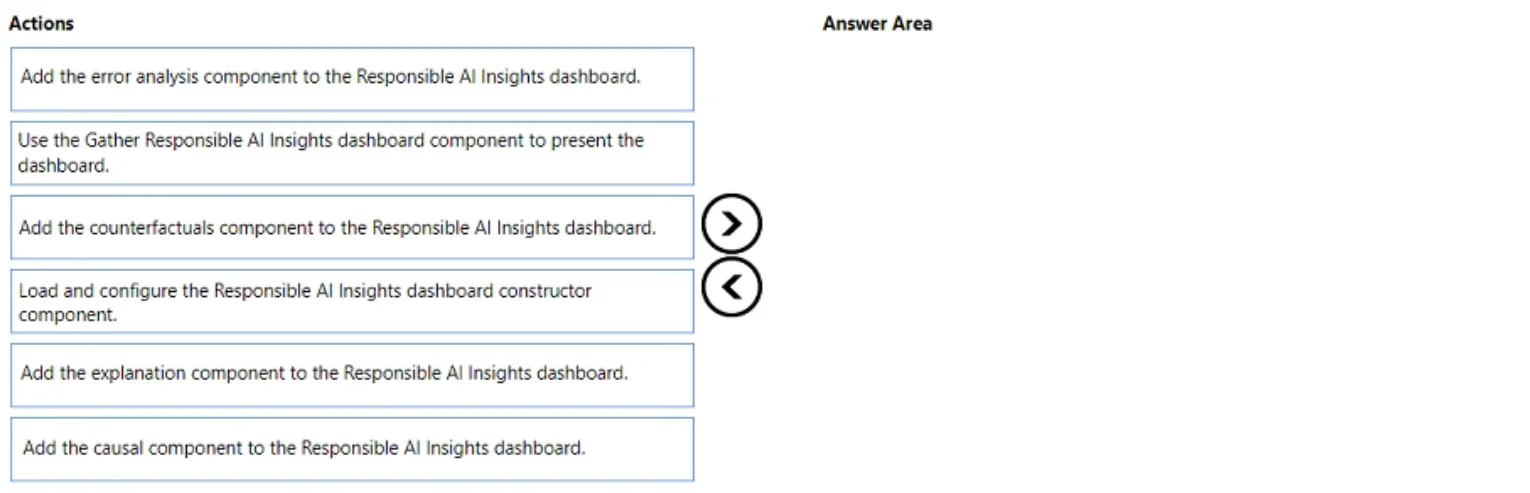
Answer Area
Drag items
Correct arrangement
- Load and configure the Responsible AI Insights dashboard constructor component.
- Add the counterfactuals component to the Responsible AI Insights dashboard.
- Use the Gather Responsible AI Insights dashboard component to present the dashboard.
Explanation
To configure the Responsible AI dashboard to identify features for modifying model predictions, one must first load the constructor, then add the counterfactuals component, and finally gather the dashboard for presentation.
Approach. The goal is to 'identify the features to modify for a differing model prediction result'. This directly relates to the concept of counterfactual explanations, which show the smallest changes to features that would flip a model's prediction.
- Load and configure the Responsible AI Insights dashboard constructor component. - This is the foundational first step for building any Responsible AI dashboard. Before adding specific components, you need to initialize the dashboard builder itself.
- Add the counterfactuals component to the Responsible AI Insights dashboard. - The problem explicitly asks to identify 'features to modify for a differing model prediction result'. Counterfactuals are designed precisely for this purpose, showing what minimal changes to input features would lead to a different model outcome. This component directly addresses the core requirement of the question.
- Use the Gather Responsible AI Insights dashboard component to present the dashboard. - After configuring the dashboard with the desired components (in this case, counterfactuals), the final step is to 'gather' or compile the dashboard for presentation and analysis. This makes the dashboard accessible to the user.
Common mistakes.
- common_mistake. Other options do not directly address the specific goal of identifying features to modify for differing model predictions:
- Add the error analysis component: This component helps identify cohorts of data where the model performs poorly, but not what feature changes would alter individual predictions.
- Add the explanation component: This provides feature importance for why a model made a particular prediction, but not what changes would lead to a different prediction.
- Add the causal component: This helps understand causal relationships between features and outcomes, which is different from identifying minimal feature changes to alter a model's prediction on a specific instance. Incorrect ordering would also be a mistake, as the constructor must be loaded first, components added second, and the dashboard gathered last.
Concept tested. Responsible AI (RAI) in Azure Machine Learning, specifically the workflow for constructing and utilizing the RAI dashboard, and understanding the purpose of its various components, particularly counterfactual explanations for model interpretability.
Topics
Community Discussion
No community discussion yet for this question.