
DEA-C02 · Question #2
How can the following relational data be transformed into semi-structured data using the LEAST amount of operational overhead?
The correct answer is C. Use the OBJECT_CONSTRUCT function to return a Snowflake object. OBJECT_CONSTRUCT is purpose-built for this exact transformation: it accepts key-value pairs from relational columns and assembles them into a single Snowflake OBJECT (a VARIANT) in one SQL expression, requiring no intermediate steps or data preparation. TO_JSON goes the wrong…
Question
How can the following relational data be transformed into semi-structured data using the LEAST amount of operational overhead?
Exhibit
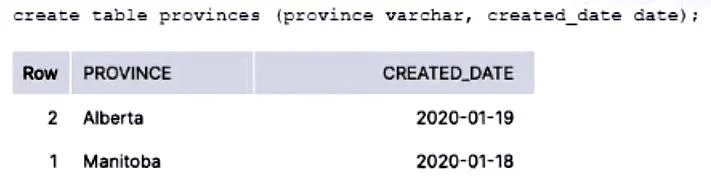
Options
- AUse the TO_JSON function.
- BUse the PARSE_JSON function to produce a VARIANT value.
- CUse the OBJECT_CONSTRUCT function to return a Snowflake object.
- DUse the TO_VARIANT function to convert each of the relational columns to VARIANT.
How the community answered
(19 responses)- A16% (3)
- B5% (1)
- C74% (14)
- D5% (1)
Explanation
OBJECT_CONSTRUCT is purpose-built for this exact transformation: it accepts key-value pairs from relational columns and assembles them into a single Snowflake OBJECT (a VARIANT) in one SQL expression, requiring no intermediate steps or data preparation. TO_JSON goes the wrong direction - it converts an existing VARIANT into a JSON string, not relational data into semi-structured data. PARSE_JSON requires a JSON-formatted string as input, meaning you'd first have to manually serialize your relational columns into a string before calling it - extra overhead. TO_VARIANT only converts individual scalar values column-by-column, so you'd need separate conversions per column and a way to combine them, making it the most operationally expensive option.
Memory tip: Think of the function names literally - OBJECT_CONSTRUCT constructs a new object from your data, which is exactly the "relational → semi-structured" direction. The others either expect semi-structured input (PARSE_JSON, TO_JSON) or work at the single-value level (TO_VARIANT).
Topics
Community Discussion
No community discussion yet for this question.