
DEA-C02 · Question #15
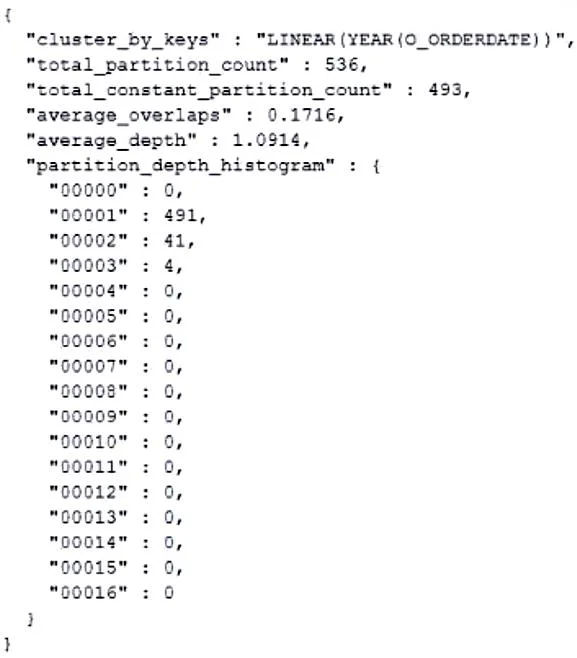
The following is returned from SYSTEM$CLUSTERING_INFORMATION() for a table named ORDERS with a DATE column named O_ORDERDATE: What does the total_constant_partition_count value indicate about this…
The correct answer is A. The table is clustered very well on O_ORDERDATE, as there are 493 micro-partitions that could. Option A is correct because total_constant_partition_count counts micro-partitions that contain only one distinct value for the clustering key - meaning every row in those 493 partitions shares the same O_ORDERDATE value. This is the definition of ideal clustering: Snowflake…
Question
The following is returned from SYSTEM$CLUSTERING_INFORMATION() for a table named ORDERS with a DATE column named O_ORDERDATE:
What does the total_constant_partition_count value indicate about this table?
Exhibit
Options
- AThe table is clustered very well on O_ORDERDATE, as there are 493 micro-partitions that could
- BThe table is not clustered well on O_ORDERDATE, as there are 493 micro-partitions where the
- CThe data in O_ORDERDATE does not change very often, as there are 493 micro-partitions
- DThe data in O_ORDERDATE has a very low cardinality, as there are 493 micro-partitions where
How the community answered
(38 responses)- A89% (34)
- B3% (1)
- C3% (1)
- D5% (2)
Explanation
Option A is correct because total_constant_partition_count counts micro-partitions that contain only one distinct value for the clustering key - meaning every row in those 493 partitions shares the same O_ORDERDATE value. This is the definition of ideal clustering: Snowflake can perfectly prune those partitions during a date-range query (fully include or fully exclude them), which is the goal of clustering.
Why the distractors are wrong:
- B inverts the logic - a high constant partition count signals good clustering, not poor clustering.
- C confuses clustering metadata with DML frequency;
total_constant_partition_countreflects value distribution within partitions, not how often data changes. - D conflates partition-level uniformity with column cardinality; a date column can have high cardinality overall and still produce constant partitions if the data is well-sorted - in fact, that's the goal.
Memory tip: Think of "constant" as "one-note" - a micro-partition singing only one date value is perfectly prunable. More one-note partitions = better clustering depth = faster queries.
Topics
Community Discussion
No community discussion yet for this question.