
DATABRICKS-CERTIFIED-PROFESSIONAL-DATA-SCIENTIST · Question #2
Suppose that the probability that a pedestrian will be tul by a car while crossing the toad at a pedestrian crossing without paying attention to the traffic light is lo be computed. Let H be a…
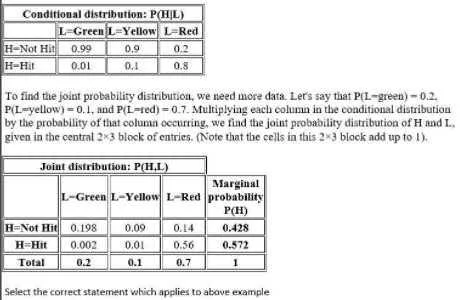
The correct answer is A. The marginal probability P(H=Hit) is the sum along the H=Hit row of this joint distribution table, as this B. marginal probability that P(H=Not Hit) is the sum of the H=Not Hit row. The marginal probability P(H=Hit) is the sum along the H=Hit row of this joint distribution table, as this is the probability of being hit when the lights are red OR yellow OR green. Similarly, the marginal probability that P(H=Not Hit) is the sum of the H=Not Hit row
Question
Suppose that the probability that a pedestrian will be tul by a car while crossing the toad at a pedestrian crossing without paying attention to the traffic light is lo be computed. Let H be a discrete random variable taking one value from (Hit. Not Hit). Let L be a discrete random variable taking one value from (Red. Yellow. Green). Realistically, H will be dependent on L That is, P(H = Hit) and P(H = Not Hit) will take different values depending on whether L is red, yellow or green. A person is. for example, far more likely to be hit by a car when trying to cross while Hie lights for cross traffic are green than if they are red In other words, for any given possible pair of values for Hand L. one must consider the joint probability distribution of H and L to find the probability* of that pair of events occurring together if Hie pedestrian ignores the state of the light Here is a table showing the conditional probabilities of being bit. defending on ibe stale of the lights (Note that the columns in this table must add up to 1 because the probability of being hit oi not hit is 1 regardless of the stale of the light.)
Exhibit
Options
- AThe marginal probability P(H=Hit) is the sum along the H=Hit row of this joint distribution table, as this
- Bmarginal probability that P(H=Not Hit) is the sum of the H=Not Hit row
- Cmarginal probability that P(H=Not Hit) is the sum of the H= Hit row
How the community answered
(22 responses)- A73% (16)
- C27% (6)
Explanation
The marginal probability P(H=Hit) is the sum along the H=Hit row of this joint distribution table, as this is the probability of being hit when the lights are red OR yellow OR green. Similarly, the marginal probability that P(H=Not Hit) is the sum of the H=Not Hit row
Topics
Community Discussion
No community discussion yet for this question.