
DATABRICKS-CERTIFIED-ASSOCIATE-DEVELOPER-FOR-APACHE-SPARK · Question #151
Which of the following cluster configurations is least likely to experience delays due to garbage collection of a large DataFrame? Note: each configuration has roughly the same compute power using…
The correct answer is D. More information is needed to determine an answer. Garbage collection (GC) pauses in Spark are primarily driven by how memory is partitioned per executor - specifically the JVM heap size, number of executor instances, and memory fraction settings. The question states only that all scenarios share ~100 GB RAM and 200 cores, but…
Question
Which of the following cluster configurations is least likely to experience delays due to garbage collection of a large DataFrame? Note: each configuration has roughly the same compute power using 100GB of RAM and 200 cores.
Exhibit
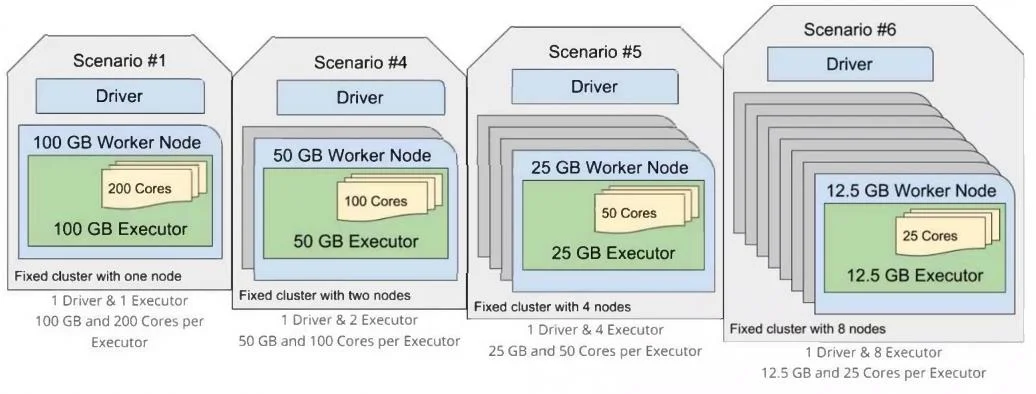
Options
- AScenario #4
- BScenario #1
- CScenario #5
- DMore information is needed to determine an answer.
- EScenario #6
How the community answered
(25 responses)- B4% (1)
- C12% (3)
- D80% (20)
- E4% (1)
Explanation
Garbage collection (GC) pauses in Spark are primarily driven by how memory is partitioned per executor - specifically the JVM heap size, number of executor instances, and memory fraction settings. The question states only that all scenarios share ~100 GB RAM and 200 cores, but does not describe the actual memory-per-executor or GC configuration for Scenarios #1, #4, #5, or #6. A configuration with many small executors (small heaps) will GC more frequently than one with fewer large executors, but without knowing those specifics, no determination can be made. Hence 'more information is needed' is the only defensible answer.
Topics
Community Discussion
No community discussion yet for this question.