
DA0-001 · Question #387
A data analyst who works for a government agency is required to obtain the average income of citizens. The list of citizens is given in the following table: A value for one citizen's income is…
The correct answer is C. Impute the mean of the other citizens' incomes into the field with the missing value. When a value is missing in a dataset, the standard data cleansing approach is to impute the mean (C) - replace the missing value with the average of the known values. This minimizes distortion to the overall distribution. Replacing with the average of only unemployed citizens…
Question
A data analyst who works for a government agency is required to obtain the average income of citizens. The list of citizens is given in the following table:
A value for one citizen's income is missing. Which of the following approaches should the data analyst take to solve this issue?
Exhibit
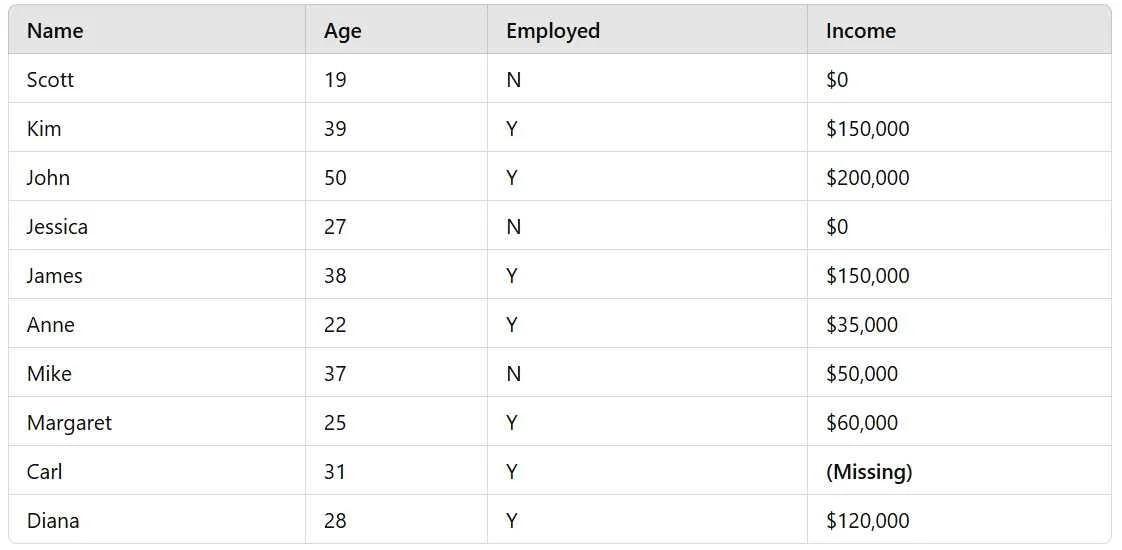
Options
- AReplace the missing value with the average of the rest of the unemployed citizens.
- BInsert the value 0 into the field with the missing value.
- CImpute the mean of the other citizens' incomes into the field with the missing value.
- DExclude employed citizens from the analysis.
How the community answered
(37 responses)- A11% (4)
- B5% (2)
- C81% (30)
- D3% (1)
Explanation
When a value is missing in a dataset, the standard data cleansing approach is to impute the mean (C) - replace the missing value with the average of the known values. This minimizes distortion to the overall distribution. Replacing with the average of only unemployed citizens (A) introduces bias by using a subset. Inserting 0 (B) is factually incorrect and would severely skew the average income calculation. Excluding employed citizens (D) reduces the dataset unnecessarily and doesn't solve the missing value problem.
Topics
Community Discussion
No community discussion yet for this question.