
DA0-001 · Question #334
A data analyst is helping a retail store categorize its customers into five different groups based on the following information: - How recently the customers made purchases - How frequently the…
The correct answer is C. Customer_ID, Order_Date, Amount. To categorize customers based on recency, frequency, and monetary value (RFM analysis), the most crucial data points are the unique customer identifier, the date of their purchases, and the amount spent per purchase. These elements allow for the calculation of all three RFM…
Question
A data analyst is helping a retail store categorize its customers into five different groups based on the following information:
- How recently the customers made purchases
- How frequently the customers made purchases
- How much the customers spent
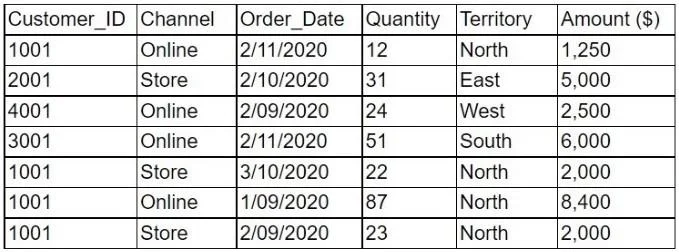
Given the following information:
Which of the following would be most important for the analysis?
Exhibit
Options
- ACustomer_ID, Channel, Order_Date
- BCustomer_ID, Territory, Amount
- CCustomer_ID, Order_Date, Amount
- DCustomer_ID, Quantity, Amount
How the community answered
(27 responses)- A15% (4)
- B4% (1)
- C78% (21)
- D4% (1)
Why each option
To categorize customers based on recency, frequency, and monetary value (RFM analysis), the most crucial data points are the unique customer identifier, the date of their purchases, and the amount spent per purchase. These elements allow for the calculation of all three RFM dimensions.
While Customer_ID and Order_Date are useful, Channel is not directly needed to calculate recency, frequency, or monetary value for customer grouping based on the specified criteria.
While Customer_ID and Amount are useful, Territory is not directly needed to calculate recency, frequency, or monetary value for customer grouping based on the specified criteria.
Customer_ID is essential for identifying individual customers. Order_Date is crucial for calculating 'how recently' (recency - from the latest date) and 'how frequently' (frequency - by counting orders over a period). Amount is necessary for determining 'how much' (monetary - by summing the amounts spent). These three fields directly enable the RFM (Recency, Frequency, Monetary) analysis needed for customer categorization.
While Customer_ID and Amount are useful, Quantity of items purchased does not directly tell 'how much' (monetary value, which is total spend), 'how recently', or 'how frequently' in the same way Order_Date and Amount do for RFM analysis. Amount represents the monetary value directly.
Concept tested: RFM analysis data requirements
Topics
Community Discussion
No community discussion yet for this question.