
DA0-001 · Question #319
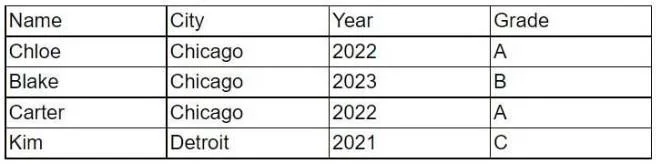
An analyst needs to summarize the number of people in Chicago in 2022 using the following set of data: Which of the following steps should the analyst use to provide results? (Choose two.)
The correct answer is A. Aggregation C. Filtering. To summarize the number of people in Chicago in 2022 from a dataset, the analyst must first filter the data to include only records for Chicago and the year 2022, then apply aggregation to count the people within that filtered subset. These two steps allow for targeted…
Question
An analyst needs to summarize the number of people in Chicago in 2022 using the following set of data:
Which of the following steps should the analyst use to provide results? (Choose two.)
Exhibit
Options
- AAggregation
- BSorting
- CFiltering
- DIndexing
- ECleaning
- FReplacing
How the community answered
(26 responses)- A85% (22)
- B4% (1)
- D8% (2)
- F4% (1)
Why each option
To summarize the number of people in Chicago in 2022 from a dataset, the analyst must first filter the data to include only records for Chicago and the year 2022, then apply aggregation to count the people within that filtered subset. These two steps allow for targeted summarization.
Aggregation is necessary to count or sum the number of people once the data has been filtered. It condenses the filtered data into a single summary statistic.
Sorting arranges data but does not summarize or select specific subsets for analysis.
Filtering is the initial crucial step to narrow down the dataset to only include records pertaining to 'Chicago' and the year '2022,' as specified by the problem. Without filtering, the aggregation would include all data.
Indexing improves data retrieval speed but does not summarize or filter the data content itself.
Cleaning addresses data quality issues but is not a direct step for summarizing specific counts based on location and year.
Replacing modifies data values but is not a step for summarizing or filtering based on the given criteria.
Concept tested: Data preparation - Filtering and Aggregation
Source: https://learn.microsoft.com/power-bi/fundamentals/service-basic-concepts#explore-your-data
Topics
Community Discussion
No community discussion yet for this question.