
DA0-001 · Question #140
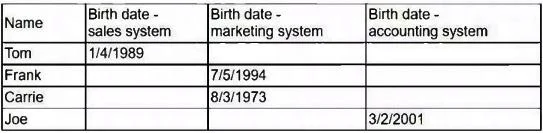
A data analyst has a set with more than 40,000 rows in the sample schema below: The analyst would like to create one column that contains the customers' birth dates. Which of the following data…
The correct answer is D. Data integrity. Creating a single, consistent column for customers' birth dates from potentially varied sources primarily addresses data integrity, ensuring the consistency and reliability of this important attribute.
Question
A data analyst has a set with more than 40,000 rows in the sample schema below:
The analyst would like to create one column that contains the customers’ birth dates. Which of the following data quality dimensions would best explain the reason for compilation?
Exhibit
Options
- AData accuracy
- BData completeness
- CData duplication
- DData integrity
How the community answered
(45 responses)- A2% (1)
- B7% (3)
- C4% (2)
- D87% (39)
Why each option
Creating a single, consistent column for customers' birth dates from potentially varied sources primarily addresses data integrity, ensuring the consistency and reliability of this important attribute.
Data accuracy refers to the correctness of individual data values, not the structural compilation of a column.
Data completeness refers to whether all required data is present, rather than the organization or consolidation of existing data.
Data duplication refers to redundant records or entries, which is a different issue from combining data into a single column.
Data integrity encompasses the overall quality, consistency, and reliability of data. Consolidating birth date information into a single, standardized column ensures that this critical data element is uniform and trustworthy, thereby improving the integrity of the customer dataset.
Concept tested: Data quality dimensions - Integrity
Source: https://learn.microsoft.com/en-us/azure/architecture/guide/data-quality/data-quality-overview
Topics
Community Discussion
No community discussion yet for this question.