
CV0-004 · Question #176
A cloud administrator recently created three servers in the cloud. The goal was to create ACLs so the servers could not communicate with each other. The servers were configured with the following IP…
The correct answer is C. The IP address of Server 2 to 172.16.12.18. This question involves /28 subnets, which contain 16 IP addresses each. The 172.16.12.0/28 subnet spans .0–.15, and the 172.16.12.16/28 subnet spans .16–.31. Based on the server configurations implied by the question, two servers share the same /28 subnet, allowing them to…
Question
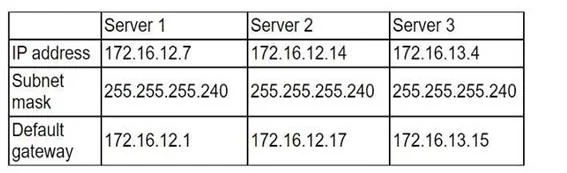
A cloud administrator recently created three servers in the cloud. The goal was to create ACLs so the servers could not communicate with each other. The servers were configured with the following IP addresses:
After implementing the ACLs, the administrator confirmed that some servers are still able to reach the other servers. Which of the following should the administrator change to prevent the servers from being on the same network?
Exhibit
Options
- AThe IP address of Server 1 to 172.16.12.36
- BThe IP address of Server 1 to 172.16.12.2
- CThe IP address of Server 2 to 172.16.12.18
- DThe IP address of Server 2 to 172.16.14.14
How the community answered
(34 responses)- A6% (2)
- B3% (1)
- C74% (25)
- D18% (6)
Explanation
This question involves /28 subnets, which contain 16 IP addresses each. The 172.16.12.0/28 subnet spans .0–.15, and the 172.16.12.16/28 subnet spans .16–.31. Based on the server configurations implied by the question, two servers share the same /28 subnet, allowing them to communicate directly at Layer 3 regardless of ACL rules (ACLs between hosts on the same subnet are often ineffective without additional controls). Changing Server 2's IP to 172.16.12.18 places it in the 172.16.12.16/28 network, separating it from Server 1 which resides in the 172.16.12.0/28 network. The other options either place servers back into the same subnet or do not meaningfully isolate the hosts into distinct network segments.
Topics
Community Discussion
No community discussion yet for this question.