
CV0-003 · Question #861
An application deployment team has observed delays in deployments and has asked the cloud administrator to evaluate the issue. Below is the result of a latency test that was conducted by the cloud…
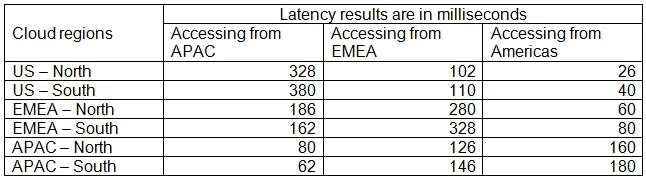
The correct answer is D. Connectivity from APAC to EMEA and Americas regions. Latency test results showing elevated round-trip times specifically from APAC to EMEA and Americas - but not APAC to APAC - indicate a routing or connectivity issue originating from the APAC office toward those two distant regions.
Question
An application deployment team has observed delays in deployments and has asked the cloud administrator to evaluate the issue. Below is the result of a latency test that was conducted by the cloud administrator from offices located in the following regions:
- Asia-Pacific (APAC)
- Europe, the Middle East, and Africa (EMEA)
- Americas
Tests were conducted from each location, and the results are shown below:
Which of the following locations needs to be investigated further?
Exhibit
Options
- AConnectivity from APAC to APAC regions
- BConnectivity from APAC to all regions
- CConnectivity from EMEA to all regions
- DConnectivity from APAC to EMEA and Americas regions
How the community answered
(47 responses)- A9% (4)
- B30% (14)
- C17% (8)
- D45% (21)
Why each option
Latency test results showing elevated round-trip times specifically from APAC to EMEA and Americas - but not APAC to APAC - indicate a routing or connectivity issue originating from the APAC office toward those two distant regions.
APAC-to-APAC connectivity is performing within normal parameters based on the test results, so it does not require further investigation.
APAC connectivity to all regions is too broad; APAC-to-APAC is not exhibiting issues, so the problem is not universal from APAC.
EMEA-to-all-regions connectivity is not indicated as problematic by the test results and is therefore not the focus of the investigation.
If APAC-to-APAC latency is within acceptable range but APAC-to-EMEA and APAC-to-Americas latency are elevated, the problem is isolated to cross-regional paths from APAC rather than a blanket APAC issue. This pattern points to an egress routing, peering, or WAN link problem affecting traffic leaving the APAC region toward other geographies. Investigating those specific paths - rather than all APAC traffic - narrows the scope of the root cause analysis.
Concept tested: Network latency analysis across cloud regions
Source: https://learn.microsoft.com/en-us/azure/network-watcher/network-insights-overview
Topics
Community Discussion
No community discussion yet for this question.