
CV0-003 · Question #488
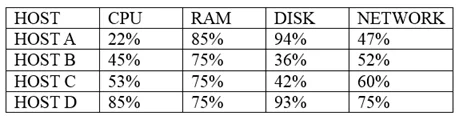
A systems administrator created several new VMs on a private cloud and wants to ensure the new baseline still meets corporate guidelines. The administrator finds the following new load numbers on…
The correct answer is C. DISK. In an N+1 host capacity model, disk is the metric most likely to cause a problem because storage capacity is a fixed resource that cannot be dynamically redistributed across hosts the way CPU or RAM can.
Question
A systems administrator created several new VMs on a private cloud and wants to ensure the new baseline still meets corporate guidelines. The administrator finds the following new load numbers on the hosts:
If corporate policy requires N+1 host capacity, which of the following metrics is MOST likely to present a problem?
Exhibit
Options
- ACPU
- BRAM
- CDISK
- DNETWORK
How the community answered
(31 responses)- A10% (3)
- B13% (4)
- C48% (15)
- D29% (9)
Why each option
In an N+1 host capacity model, disk is the metric most likely to cause a problem because storage capacity is a fixed resource that cannot be dynamically redistributed across hosts the way CPU or RAM can.
CPU is highly elastic and can be overprovisioned via time-slicing by the hypervisor, giving administrators significant headroom before N+1 thresholds are breached.
RAM can be managed through memory ballooning, transparent page sharing, and swap, giving more flexibility than the rigid capacity of disk.
Unlike CPU or RAM, which hypervisors can balance through scheduling and memory techniques, disk capacity and I/O are typically provisioned as fixed allocations per VM - when a host is lost in an N+1 failure scenario, the remaining hosts must absorb its full storage workload, and disk is the least elastic resource, making it the first metric to breach policy thresholds when new VMs are added.
Network bandwidth is shared infrastructure managed through QoS and virtual switching policies, and is rarely the first resource to fail N+1 capacity requirements.
Concept tested: N+1 host capacity planning in private cloud
Source: https://docs.vmware.com/en/VMware-vSphere/8.0/vsphere-availability/GUID-C4059DB4-F6C2-4B58-A2DC-4CC5082B6E77.html
Topics
Community Discussion
No community discussion yet for this question.