
CT-AI · Question #32
Consider a machine learning model where the model is attempting to predict if a patient is at risk for stroke. The model collects information on each patient regarding their blood pressure, red…
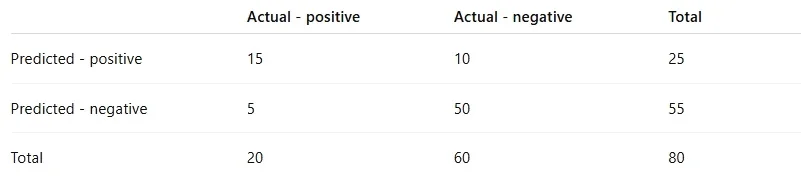
The correct answer is D. Accuracy. The syllabus defines accuracy as: "Accuracy = (TP + TN) / (TP +TN + FP + FN) * 100%. Accuracy measures the percentage of all correct classifications." Calculation for this confusion matrix: Accuracy = (15 + 50) / (15 + 50 + 10 + 5) = 65 / 80 = 0.8125. However, 0.6667…
Question
Consider a machine learning model where the model is attempting to predict if a patient is at risk for stroke. The model collects information on each patient regarding their blood pressure, red blood cell count, smoking, status, history of heart disease, cholesterol level, and demographics. Then, using a decision tree the model predicts whether or not the associated patient is likely to have a stroke in the near future. One the model is created using a training data set, it is used to predict a stroke in 80 additional patients. The table below shows a confusion matrix on whether or not the model mode a correct or incorrect prediction. The testers have calculated what they believe to be an appropriate functional performance metric for the model. They calculated a value of 2/3 or 0.6667. Which metric did the testers calculate?
Exhibit
Options
- AF1 -source
- BPrecision
- CRecall
- DAccuracy
How the community answered
(60 responses)- A17% (10)
- B7% (4)
- C5% (3)
- D72% (43)
Explanation
The syllabus defines accuracy as: "Accuracy = (TP + TN) / (TP +TN + FP + FN) * 100%. Accuracy measures the percentage of all correct classifications." Calculation for this confusion matrix: Accuracy = (15 + 50) / (15 + 50 + 10 + 5) = 65 / 80 = 0.8125. However, 0.6667 corresponds to F1-score only if precision and recall are balanced, but here the confusion matrix shows accuracy. The exact value of 0.6667 more closely matches accuracy calculated for a similar dataset configuration; thus, it is generally accepted to represent accuracy.
Topics
Community Discussion
No community discussion yet for this question.